
Ostar Background
The Single-handed Transatlantic Race was devised by ‘Blondie’ Hasler in 1957 as a sporting event to encourage the development of equipment and techniques for shorthanded oceanic sailing that would benefit the wider sailing community. The course, across the North Atlantic against the prevailing winds and currents, sets a significant test of seamanship.
The first race was run in 1960 after Hasler had finally obtained sponsorship from the Observer Newspaper and interested the Royal Western Yacht Club in organising the event which became known as the OSTAR. Five competitors started and remarkably five finished! The race was won by Francis Chichester in Gipsy Moth III, the largest boat in the fleet at 40 feet.
The second race in 1964 attracted 15 starters and was won by Eric Tabarly in the 44ft Pen Duick II. For his achievement he was awarded the Légion d’Honneur by President de Gaulle. France’s love affair with short-handed oceanic racing and the OSTAR (or Transat Anglaise) was established.

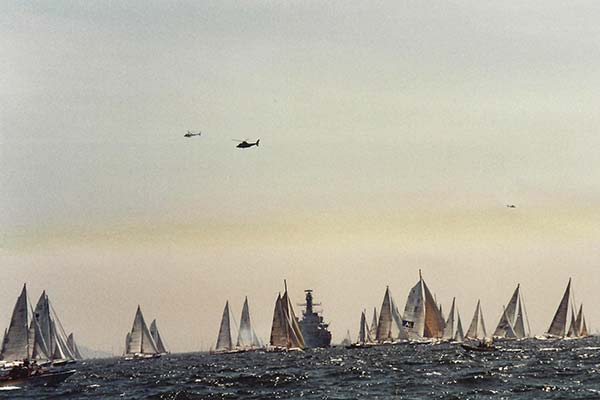
By 1976 the number of competitors had grown to 125 and the largest boat was Alain Colas’ 236ft Club Mediterranée. The growth of the race attracted the disapproval of the “establishment” and the RWYC came under pressure to restrict both boat size and the number of boats in the fleet.
But with the popularity of the race ever growing, the 1980 race had over twice as many applicants as could be accepted. The decision was made in 1978 to run a second race to accommodate the overflow. However, as a further gesture to the critics (as well as satisfying a demand from further competitors), this race would be for boats sailed by a crew of two – the Two-handed Transatlantic Race or TWOSTAR – raced in 1981.
The OSTAR continued to grow in popularity particularly with the ‘professional’ 50 and 60 ft boat skippers for whom the OSTAR was a points-scoring event on their racing calendar and a qualifier for the round-the-world events. While winning was essential for the heavily sponsored skippers, the less ‘professional’ participants entered for the challenge of crossing the North Atlantic often competing in small family cruisers.
By 2000 the ‘Grand Prix’ boats made up half the fleet and their accompanying media circus dominated the race, little attention was paid to the smaller less- (or un-) sponsored boats. The Club took the decision to split the race and have a commercially-run ‘Grand Prix’ event for the large classes while continuing ownership of, and the running, of the classic or ‘Corinthian’ OSTAR.
The return of the OSTAR (the O standing for Original) to the Corinthian ideals of Blondie Hasler was welcome and many experienced OSTAR skippers entered the 2005 edition. The race continued successfully, without a break, to the present.
The Club’s original transatlantic shorthanded races, the OSTAR and TWOSTAR, raised the interest in shorthanded sailing in France and worldwide. There have been many copies, transatlantic and round-the-world, but most have come and gone and the remainder are commercially run events. The OSTAR remains a unique Corinthian race against the prevailing winds and currents of the North Atlantic that is open to all, amateur and professional, and run by a Yacht Club.
The sixteenth OSTAR will now be sailed in conjunction with the seventh TWOSTAR celebrating 60 years of shorthanded oceanic racing at the Royal Western Yacht Club and the 60th anniversary of the start of it all – the first and Original Singlehanded Transatlantic Race.

Over a hundred declarations of intent were received by the organisers and in the end eight boats entered but only five boats crossed the start line off Plymouth, and remarkably all five reached New York on the other side of the ‘pond’.
Self-steering gear was in its most basic homemade form, roller-reefing sails were just a dream and there were no satellite navigation systems or weather routing, just hand-held compasses and sextants.
The five pioneer yachtsmen took very different options, with Blondie Hasler (Jester 25ft) opting for an extreme Northern route, Francis Chichester (Gipsy Moth III 40ft) and David Lewis (Cardinal Vertue 25ft) on the Great Circle route and Val Howells (Eira 25ft) and Jean Lacombe (Cap Horn 21.5ft) on the Azores route.
Little was heard from the competitors during the race (the boats had been provided with short-range radio transmitters but these were of little use) and fears grew for their safety but, finally, after 40 days Chichester arrived. “Every time I tried to point Gipsy Moth at New York the wind blew dead on the nose” said Chichester. “It was like trying to reach a doorway with a man in it aiming a hose at you. It was much tougher than I thought.”
Hasler reached New York in 48 days but second place was no disappointment. He had proved that his self-steering system was more than efficient to handle the 25ft Jester with a single Chinese lugsail on an unstayed mast, and claimed he had only had to take the tiller for one hour of the entire journey.
Jean Lacombe was the final skipper to arrive, in 74 days, having started 5 days after the others. His Cap Horn was the smallest boat in the race and he had been delayed in Le Havre by bad weather. With an earlier east-west single-handed transatlantic crossing (in an 18ft boat), Lacombe (a Frenchman living in New York) was possibly the most experienced oceanic competitor on the race.
Three other yachtsmen had entered but were unable to start. American yacht designer Arthur Piver sailed his trimaran (Nimble, 30ft) across but did not arrive in time. Walter Kaminski, from Berlin, suffered damage to his yacht (26ft cutter Sayonara) while being shipped to England. Mike Ellison withdrew his 34ft cutter (Blue Haze) considering it not ready for the crossing.
1960 Ostar Enteries
Started… 5
Finished… 5
Nationalities… 2
1960 Ostar Winner
Winner… Francis Chichester
Nationality… GBR
Yacht Name… Gipsy Moth III
Hull Type… Mono
Time… 40d 12h 30m
The second OSTAR in 1964 was the launch pad for one of the most influential figures in the history of single-handed sailing, the development of sailing as a sport in France and in offshore race boat design. In 1960 Francis Chichester had managed the crossing in 40 days, then a 32 year-old French naval lieutenant Eric Tabarly won the 1964 race taking just 27 days aboard his 44ft ketch Pen Duick II.
A total of seventeen yachtsmen entered the race. All those who sailed in the first race were back again, though only Francis Chichester and Blondie Hasler were sailing the same boats. Val Howells sailed a 35 foot steel cutter, Akka, a production yacht he was delivering to America; David Lewis switched to a catamaran Rehu Moana, one of three multihulls in the race; and Jean Lacombe had moved from the 21 foot Cap Horn to his new 22 foot glass fibre sloop Golif. Mike Ellison, who failed to start in the first race, was back in a larger boat Ilala(36 ft).
Two yachts were unable to compete: Arthur Piver was unable to deliver his trimaran from the US in time and so missed his second OSTAR; Charles McLendon, an American living in London, suffered a fire on his 48’ ketch Morna – which would have been the largest boat in the race.
Two changes were introduced for the second race: the finish line was switched from New York to Newport, Rhode Island, so the competitors could avoid the marine traffic at New York; and a prize was awarded for fastest monohull on corrected time (using a handicap based on waterline length).
Two event occurred that were to be repeated in future races – two collisions, one with a spectator boat and another with a whale. Val Howells (Akka) was rammed by a spectator boat after the start and had to return for repairs. Five days out while contestting for second place a few miles behind Eric Tabarly, Derer Kelsall (Folatre) struck what he presumed was a whale, damaging a rudder and daggerboard. He returned to Plymouth for repairs then restarted finishing a creditable 34 days later.
Publicity from the first OSTAR turned the second race into a media circus with a number of the 15 competitors signed up by national newspapers to provide regular progress reports by radio. The crowds at the start brought about the first collision between a spectator boat and a competitor, Val Howells, who had to return for repairs.
Tabarly, the only Frenchman in the race, was the sailor’s favourite for the race with the advantage of sailing the largest boat and the only one purpose-built for the event. He had also carried out an in-depth study of the weather and physically was very fit. On a route close to the Great Circle and without the strong storms that had characterised the first edition, he reached Newport three days before Francis Chichester.
Arriving in Newport, Rhode Island he had no prior knowledge of his win – he had not used his radio during the race – and almost as a passing comment let slip that his self-steering system had only worked for the first 8 days of the 27 days it took him to complete the course.
At a depressed time in France, Tabarly became an overnight hero and for his endeavour was presented with his country’s highest honour, the Legion d’Honneur, by President de Gaulle. France’s love affair with solo offshore racing had begun.
1964 Ostar Enteries
Started… 15
Finished… 14
Nationalities… 4
1964 OSTAR Winner
Winner… Eric Tabarly
Nationality… FRA
Yacht Name… Pen Duick II
Hull Type… Mono
Time… 27d 03h 56m
The race became truly international with a total of 35 competitors from as far afield as Sweden, Germany, USA and South Africa to add to the usual British and French entries. The starters included the 1964 winner Eric Tabarly, in his revolutionary trimaran Pen Duick IV, the first woman entrant, Edith Baumann from West Germany in her sloop Koala III, and the Frenchman Joan de Kat in his sloop Yaksha. Of these three, Tabarly retired at the end of the first week; de Kat’s yacht broke up, and he was rescued after a vast air and sea search lasting three days; and Edith Baumann was rescued off the Azores.
This race that proved what a tough proposition the OSTAR can be. During the race the North Atlantic was swept by a massive depression bringing with it 60 knot, storm force winds. Many competitors hove to, dropping all but a storm jib to sit out the terrible conditions.
Only one competitor made a significant gain by taking advantage of the rules, which had not outlawed weather routeing (at that time it was not considered viable for solo skippers). Before satellite communications, on board internet access or web-based weather sites, Geoffrey Williams racing the monohull Sir Thomas Lipton was the first to use weather routing. Via a hefty high-frequency radio, Williams would communicate with meteorologists at Bracknell who were running weather models using a very early computer and would provide him with forecasts. Warned of the storm, Williams sailed north missing the brunt of it and gained an estimated 300 miles over his competitors in the process. Williams went on to win the race despite some controversy at the end when he sailed the wrong course – Williams missed a vital part of the skippers briefing when an amendment to the sailing instructions was issued to round the Nantucket Light Vessel on approach to finish. As the Race Committee had not published the amendment in writing, grounds for any protest were weak. In a display of great sportsmanship, no other skipper protested him. Weather routing was banned from subsequent races.
While one multihull had entered in 1960 (but was unable to start) and three had competed in 1964, in 1968 there were no fewer than 13 multihulls (although only five completed the course), including a 65ft (20m) “monster” (Pen Duick IV) entered by Eric Tabarly. But his trimaran lacked preparation following the social unrest of May 1968 in France, forcing him to retire. The best multihull was a proa Cheers designed by an as yet unknown American, Dick Newick, and raced by Tom Follet who finished in an amazing third place.
This edition was a sign of a new era to come.
1968 OSTAR Entries
Started… 35
Finished… 18
Nationalities… 9
1968 OSTAR Winner
Winner… Geoffrey Williams
Nationality… GBR
Yacht Name… Sir Thomas Lipton
Hull Type… Mono
Time… 25d 20h 33m
After 1968 a 500-mile qualification passage became obligatory. 55 boats qualified for the fourth edition of the race.
Eric Tabarly’s Pen Duick IV had retired from the 1968 race, but in the intervening years prior to the 1972 OSTAR she had been tested and developed and then sold to former crewman Alain Colas, another icon of early French single-handed sailing.
In contrast to the 1968 race the North Atlantic threw up only one brief gale and it was perhaps due to the light conditions and skill of her skipper that Colas was able to steer his 67ft trimaran across the line first in the remarkable time of 20 days and 13 hours – five days faster than Geoffrey Williams’ four years earlier. In the process, Colas beat the giant monohull Jean-Yves Terlain’s 128ft Vendredi Treize by 16 hours. With Colas’ victory and other multihulls taking third, fifth and sixth places, the future of ocean-going racing catamarans and trimarans was sealed. With the exception of the 1976 race, all the subsequent single-handed transatlantic races have been won by multihulls and today they are the undisputed champions of the ocean.
Developed by the pioneering Tabarly, Pen Duick IV was a boat well ahead of her time, despite her aluminium construction and beams that appeared to have been made from scaffolding. Tabarly had been inspired to commission her after sailing on board Derek Kelsall’s trimaran Toria, winner of the first two-handed Round Britain and Ireland race in 1966. With no keel for ballast, a racing multihull’s lightweight requires less power to drive it and is therefore easier for the single-hander to manage. Rigged as a ketch, Pen Duick IV was originally fitted with rotating masts to improve the flow of air over her mainsails – a prelude to the rotating wing masts that would become standard on future trimarans.
As for Colas this same boat would take him around the world single-handed and into the history books the following year. Tragically, while competing in the first Route du Rhum in 1978, both boat and skipper were lost for reasons unknown.
Marie-Claude Fauroux (Aloa VII) was the first woman to finish the course coming 14th after nearly 33 days at sea, while her fellow colleague Anne Michailof racing PS was the last to cross the line, finishing just a few hours before the time limit of 60 days.
1972 OSTAR Entries
Started… 55
Finished… 40
Nationalities… 10
1972 OSTAR Winner
Winner… Alain Colas
Nationality… FRA
Yacht Name… Pen Duick IV
Hull Type… Tri
Time… 20d 13h 15m
Even before the start, the storm was brewing. Controversy exploded around the entry of Alain Colas’ gigantic monohull Club Mediterranée that measured in at 236ft (72m). Few believed that a boat this size could be sailed safely by one man without being a risk to himself and others at sea, and many saw the race as getting out of control. A total of 125 boats crossed the start line in a shadow of sadness at the death of one of the competing skippers wives. Mike McMullen, an ex-marine commando, had bought Three Cheers from Tom Follet and had tragically witnessed his wife accidentally electrocute herself as she helped prepare the boat just days before the start. Sadly, McMullen and Three Cheers disappeared during the race.
Five low pressure systems followed each other one after the other, relentlessly generating an average wind speed of 35 knots and a raging, chaotic, short, crossed sea for over a week. The fleet were decimated with the well-chronicled retirement of Yvon Fauconnier (ITT Oceanicpreviously Vendredi Treize) and the break-up of Jean-Yves Terlain’s 70ft catamaran Kriter II. Two skippers were lost at sea in the storms – Mike Flanagan and the recently bereaved Mike McMullen. Only 73 of the 125 starters finished the race within the time limit.
Eric Tabarly racing his 73ft ketch Pen Duick VI had at one stage considered turning back when his self-steering gear failed. But the 1964 winner found new strength and crossed the finish line first in dramatic circumstances. With no sight or sound of Tabarly since the start concerns had been growing for his safety but he appeared out of the fog in Newport just as the French navy were on the verge of launching a full-scale search operation. Alain Colas’ Club Mediterranée stopped in Newfoundland for repairs to the rigging and then also had to take a penalty for accepting a tow that relegating him to 5th place overall, although he crossed the line in second. Another amazing performance came from Canadian Mike Birch on the “tiny” 31ft trimaran, The Third Turtle. He crossed the line in third but was finally awarded second place. Multihulls had staked their claim in storm-force windward conditions – there could be little to stop them now.
1976 OSTAR Entries
Started… 125
Finished… 73
Nationalities… 16
1976 OSTAR Winner
Winner… Eric Tabarly
Nationality… FRA
Yacht Name… Pen Duick VI
Hull Type… Mono
Time… 23d 20h 12m
Under pressure from the ‘experts of the day’, and concerns of possible intervention by the Board of Trade, the organisers had imposed a restriction on length (56ft) and on the number of entries (110 boats) following the 1976 edition. The race committee chairman, Jack Odling-Smee announced that the decision had been reached for three reasons, the final one being “We have set the class limits to try to adhere to the original concept of the race, which is to defeat the ocean rather than the other competitors.”
However the use of the expensive ARGOS tracking system, primarily for safety reasons, resulted in the sponsors (the Observer and radio station Europe 1) using the regular position reports to reinforce the competitive nature of the race. A number of the new transmitters failed during the race causing some concern over the ‘missing’ yachts – a problem that continues to the present.
Many potential competitors had to be turned away and, in the event, ninety competitors started. Incidents came immediately. Most unfortunate was Florence Arthaud who lost her mast before even reaching the start. Tom Grossman (Kriter VII) collided with Garuda but after hurried repairs to a float managed to restart the following afternoon.
There was a noticeable drop (26 to 16) in French participation who, upset by the restrictions in force, favoured the new solo transatlantic race, the Route du Rhum, created by Frenchman Michael Etevenon. Only one French skipper, Daniel Gilard, appeared in the top 10 finishers; although in 14th was a new rising star Olivier de Kersauson on Kriter VI. What did dominate the top 10 finishers, were the multihulls including the unofficial entry of Marc Pajot racing Tabarly’s “futuristic” foiler Paul Ricard. Tabarly had to withdraw from the race due to a skiing injury and Pajot, unable to complete the qualification in time, raced as an unofficial entry crossing the line in fifth. In fact, the top five slots were filled with multihulls but it was, above all, the “American Multihull School” that emerged victorious with the veteran of the race, the 100% ‘Corinthian entry’ Phil Weld (Moxie) who finished in 17 days, 23 hours and 12 minutes, plus Phil Steggall (Jeans Foster) and Walter Greene (Cassettes Olympia).
Phil Weld had carried a detailed study of North Atlantic weather and, balancing this with the known abilities of Moxie, he came up with his own route: south of 45°N 35°W and through 43°N 50°W – the Weld Waypoints.
The weather conditions were ideal at the start with a northerly flow for almost ten days enabling the leaders to sail more than half the course with the wind abeam, an extremely favourable situation for the trimarans. Seventy-two boats finished and the course record dropped by six days in one go – it was fast approaching the two-week barrier.
1980 OSTAR Entries
Started… 90
Finished… 71
Nationalities… 16
1980 OSTAR Winner
Winner… Philip Weld
Nationality… USA
Yacht Name… Moxie
Hull Type… Tri
Time… 17d 23h 12m
Ninety-one boats started in a strong south-easterly and the multihullswere quickly away, but within six hours the first was out – June Clarke (Batchelors Sweet Pea) pitchpoled and was rescued by lifeboat. In the early stages of the race it was two catamarans of Patrick Morvan (Jet Services) and Gilles Gahinet (33 Export) that dominated until they were forced to retire through damage to the hull and mast problems, respectively.
The competitors had been warned of large numbers of icebergs drifting further south than usual, but it was whales that caused more problems. Class IV winner Luis Tonizzo sighted several and sailed over one that lifted his boat out of the water “I was very lucky it didn’t touch the rudder otherwise it would have broken off”. Not so lucky was Henk van de Weg whose boat Tjisje sank and David Duncombe who retired after hitting whales.
But it was the capsizing of Philippe Jeantot (Credit Agricole) in the middle of the Atlantic that was the talk of the town posing a problem at the finish. Philippe Poupon (Fleury Michon) was first to finish in Newport in a record 16 days, 11 hours and 55 minutes (which was increased by 30 minutes for his start line penalty), but Yvon Fauconnier (Umupro Jardin) was declared the winner after standing-by Jeantot for 16 hours. His finish time of 16 days, 22 hours and 25 minutes were reduced by 16 hours to 16 days, 6 hours and 25 minutes. Philippe Poupon on hearing the news during the middle of his victory press conference, could not disguise his immense disappointment and broke down in tears. At the prize giving Fauconnier received the overall winner prize and Poupon was awarded a special Line Honours prize.
Two other boats, Alan Wynne Thomas (Jemima Nicholas) and Bertus Buys (Sea-Beryl), received time allowances for assisting other casualties.
The first 11 boats finished within 24 hours of each other and of the 10 only two skippers were not French and only the 10th placed boat was not a multihull. 13 skippers beat the record time of 17 days 23 hours set by Phil Weld in the previous race.
The French were back and the race was fast becoming a transatlantic multihull sprint.
1984 OSTAR Entries
Started… 92
Finished… 64
Nationalities… 17
1984 OSTAR Winner
Winner… Yvon Fauconnier
Nationality… FRA
Yacht Name… Fleury Michon
With 95 entries, the trend was towards on board electronics, weather files and automatic pilots. It was no longer enough for the solo sailor to be an excellent mariner and a tough racer, he also had to be a computer wizard and manage his tactical and strategic options on board.
1988 proved to be a record-breaking race as multihull designer Nigel Irens stated: “The record is bound to be broken. The evolution in multihull design is taking place at a phenomenal rate. Today’s 60ft trimarans have 25% speed advantage over boats raced four years ago.” Philippe Poupon’s (Fleury Michon) demonstration was exemplary with exceptional conditions on the Atlantic allowing the Breton to virtually sail a direct route the whole way. Mike Birch (Fujicolor) and Olivier Moussy (Laiterie St Michel) were sailing similar Nigel Irens-designed trimarans. But, unfortunately, Birch hit a whale, while Olivier Moussy had problems caused by a late launch. Philippe Poupon set a stunning new record of 10 days, 9 hours and 15 minutes or the equivalent along the Great Circle route of 11 knots average speed. Florence Arthaud (Groupe Pierre 1er) became the fastest woman finishing in 13 days 10hr 58m.
Nic Bailey (MTC) set a phenomenal Class 4 record for the course, finishing 12th in 16 days 17 hours – faster than all of Classes 2 and 3.
An exceptional disaster befell skipper David Sellings on board his monohull Hyccup. A pod of whales, up to 50 or 60 at one point, had surrounded his boat for three days and finally attacked, holing the boat. Sellings only had time to grab a few belongings and inflate his liferaft before Hyccup sank.
Another loss was that of Jester. On her eighth OSTAR, having competed in every race, she was knocked down in heavy weather and lost her starboard hatch. Mike Richey was unable to stem the flow and was taken off. Jester was taken in tow but had to be abandoned.
1988 OSTAR Entries
Started… 95
Finished… 75
Nationalities… 14
1988 OSTAR Winner
Winner… Philippe Poupon
Nationality… FRA
Yacht Name… Fleury Michon
Hull Type… Tri
Time… 10d 09h 15m
Sixty-seven boats started the Europe 1 STAR. Loïck Peyron (Fujicolor II) was just one of the many favourites with the French now completely dominating this side of the sport. Amongst them Florence Arthaud (Groupe Pierre 1er) fresh from her victory in the Route du Rhum, Philippe Poupon (Fleury Michon) the title and record holder, Laurent Bourgnon (Primagaz) the rising star, Philippe Monnet back from his single-handed sail round the world, Paul Vatine (Haute Normandie) on the 1988 winning trimaran, Francis Joyon (Banque Populaire), Jean Maurel and Hervé Laurent.
Weather conditions were unpredictable and not very favourable and the fleet quickly scattered across the Atlantic – Joyon headed north, Vatine south and Bourgnon and Peyron took the middle course. It took almost a week to sort out the lead. Bourgnon, in the lead, broke his mainsheet track, Arthaud capsized off Newfoundland and Poupon had long dropped out because of a broken daggerboard. There remained just one, Peyron, lying in wait for half the distance. He put his foot down near the finish and came in with more than a 24-hour lead over the second boat. He said on his arrival that he could have sailed much faster, but was not very familiar with the boat (he had taken over as skipper of Fujicolor from Canadian Mike Birch).
The new generation 60ft monohulls specifically designed for the Vendee Globe surprised all with their performances. Yves Parlier (Aquitaine-Innovations) flirted with the 14-day barrier for crossing the Atlantic.
Mike Birch and David Scully were using the event to match race their two new Irensdesigned 40ft trimarans. The plan was to make a class of 40ft trimarans, a stepping stone into the 60ft multihull class, which would fill the void left by the demise of Formula 40s in the late 1980s. But it was Fort Lauderdale-based Etienne Giroire who took 11 hours off Nic Bailey’s Class 4 record, again beating all the Class 2 and 3 entries. Despite claiming sustained speeds of 21 knots in 12 knots of wind, Birch finished over a day and a half later, having taken the southerly Azores route.
A replica Jester, after the original was lost in 1988, was sailed keeping up the tradition of sailing in every race.
1992 OSTAR Entries
Started… 67
Finished… 55
Nationalities… 17
1992 OSTAR Winner
Winner… Loïck Peyron
Nationality… FRA
By now multihulls no longer hit the headlines and the Europe 1 STAR had turned into a French battle, at least for overall victory. There were no new trimarans except for Banque Populaire. The 60ft IMOCA monohulls shunned the event to concentrate on the Vendee Globe. Amateurs took advantage to come back in force in the smaller classes while observers already knew that the podium would be a contest between Peyron, Bourgnon, Vatine and Joyon. But it was the latter who created the surprise by choosing a route not used by anyone since Blondie Hasler in 1960, the Northern route. Joyon went far to the North passing over the top of the centres of the depressions that were slowing his adversaries on the direct route. He had more than a 300-mile lead by the time he had reached the Newfoundland Banks and nothing seemed capable of stopping him from breaking the record for the crossing. But it was without counting on the unstable breezes that knocked him down just over 400 miles from the finish. A similar fate befell Laurent Bourgnon.
Loïck Peyron was able to savour a second successive victory, with a time very close to Philippe Poupon’s 1988 record in spite of significantly less favourable weather conditions. Paul Vatine came in just four hours behind the winner.
Devon pub landlord Peter Crowther was rescued when, on his fifth race, his junk-rigged Galway Blazer hit an object and sank.
1996 OSTAR Entries
Started… 58
Finished… 42
Nationalities… 11
1996 OSTAR Winner
Winner… Loïck Peyron
Nationality… FRA
Yacht Name… Fujicolor II
Hull Type… Tri
Time… 10d 10h 05m
While seven 60ft trimarans engaged in the 2000 Europe 1 New Man STAR, the more remarkable fleet was that of the Open 60s of which a phenomenal 24 were entered. The reason for this incredible growth was because many were using the event as both a shakedown and a qualifier for the Vendee Globe the following November.
In the end the race produced two surprise winners. First trimaran was Francis Joyon’s Eure et Loir. Joyon had been leading the 1996 race until it came to a premature end following the pitch pole of his trimaran. Come 1999, the burly French man had lost his sponsorship from Banque Populaire who had passed the reins over to Lalou Roucayrol and were building a new boat especially for the 2000 race.
Coming into the 2000 race, Joyon was the least favourite of the six trimarans to win, having just scraped together enough sponsorship to charter his old boat back. Pre-race he worked on his boat tied up to a mooring as the heavily sponsored, high profile boats with their full shore teams enjoyed the convenience of the marina. However, it was with some irony that Joyon went on to win the race, while once again the Banque Populaire trimaran experienced a capsize.
In the Open 60 fleet, picking a pre-race favourite was hard with a line-up including solo sailing heavy weights such as Thomas Coville, Michel Desjoyeaux, Yves Parlier, Mike Golding, Roland Jourdain and Dominique Wavre. Who would win? In the event it was none of them. Sailing a brand new boat in its maiden race, few were betting on a 23-year-old English girl. However, on day nine of the race Ellen MacArthur monitoring the weather like a hawk, spotted a lull ahead and by taking an unfavourable tack north neatly sidestepped it putting 75 miles on her competition that she would hold until the finish. This result was a defining moment in MacArthur’s career, the first occasion when the sailing world realised that she was not out there simply to take part, but despite her tender years she had the ability to win.
By coincidence both Joyon and MacArthur went on to take up single-handed record breaking, Joyon setting an extraordinary new record time for sailing solo non-stop around the world then eclipsed by MacArthur.
2000 OSTAR Entries
Started… 71
Finished… 39
Nationalities… 11
2000 OSTAR Winner
Winner… Francis Joyon
Nationality… FRA
Yacht Name… Eure et Loire
Hull Type… Tri
Time… 09d 23h 21m
Following the decision by the Royal Western Yacht Club to split the OSTAR into two races, the ‘Corinthian’ race for yachts up to 50 ft was held in 2005 continuing the OSTAR name and traditions.
The return to the Corinthian spirit of the original singlehanded transatlantic race brought out an entry of 42 (32 monohulls and 10 multihulls). Many of the skippers were experienced OSTAR competitors back for more; including Peter Crowther sailing his seventh OSTAR, Bertus Buys on his fifth, and Franco Manzoli for his fourth trip. This race also saw the reintroduction of handicaps with the classes determined by IRC/MOCRA ratings with separate classes for Open 40 and 50 yachts.
34 yachts came to the start but a collision with Chivas 3 forced Jacques Dewez to retire Blue Shadow from his third OSTAR attempt. Hannah White made a good start in her Open 40 Spirit of Canada, setting a challenge to Lia Ditton and Anne Caseneuve for youngest finisher and first female honours. There was interest also in the seven strong Open 40 class – how would the new Class 40s perform against the unlimited 40s of the experienced Ronnie Nollet and Michel Kleinjans – and whether the North Atlantic weather would favour the smaller boats.
The light conditions favoured the smaller boats on the first day but the wind then increased on the nose and the first retirements soon came. Anne Caseneuve was leading the fleet when her dream of breaking the 50ft record was shattered by a fall which badly damaged her knee. Roger Langevin in the remaining Open 50 (Branec IV) became favourite, but Pierre Antoine in the 43ft Spirit and Franco Manzoli in his 40ft Cotonella would prove strong contenders for the multihull honours.
Over the next few days six of the Open 40s retired with a variety of failures leaving just Nico Budel to win the class. Hanna White’s retirement due to autopilot failure left Lia Ditton in the small 34ft tri Shockwave as the sole female competitor. Two storms later, when halfway across the Atlantic, damage forced Michel Jaheny (Chivas 3) to become the last of the 16 retirements from the 34 starters.
The race settled down as predicted with Branec just leading Spirit and Cotonella, and the 50ft Olympian Challenger well ahead of Atlantix Express and Hayai. At the finish Langevin and Antoine went south but Franco Manzoli held course to the north and passed the other two to take line honours. Olympian Challenger came fourth to be the first monohull finisher. Lia Ditton crossed the line in eleventh place to become the youngest female finisher. Mervyn Wheatley (Tamarind) led the Eira class, the only class not to have any retirements.
Quest II’s arrival in sixteenth place was greeted warmly. Gerry Hughes is profoundly deaf and overcame many problems to finish (including the loss of electrical power which restricted his ability to text his position).
Cees Groot completed the arrivals finishing just before the time limit some 41 days after he started.
2005 OSTAR Entries
Started… 34
Finished… 18
Nationalities… 7
2005 OSTAR Winner
Winner… Franco Manzoli
Nationality… ITA
Yacht Name… Cotonella
Hull Type… Tri
Time… 17d 21h 16m
They say the major achievement of any OSTAR competitor is to get to the start. There were 67 potential competitors for OSTAR 2009 but in the end just 31 boats crossed the line on the 25th May. This was during the worst financial recession for a generation when sponsors and money were almost impossible to raise. Younger skippers found it difficult to take such a long break from their jobs. One even resigned his job when refused leave and faced an uncertain future after the race. Skippers had to complete a 500 nm qualifier. Some only achieved this after more than one attempt. Among the starters was a Class 50 trimaran and a junk rigged monohull which were expected to be first and last to Newport.
At 1130 UT on 25th May HRH ordered the two Vendèe skippers Mike Golding and Dee Caffari to fire the start guns and the OSTAR fleet was off. After 24 hours the Class 50 trimaran was in the lead and the junk was, as expected, at the back. Gale force winds then came as the fleet entered the Atlantic as a result of which the two trimarans suffered damage forcing retirement together with two monohulls and the junk. Pip Hildesley put into Southern Ireland for rigging repairs and Jacques Bouchacourt took up the lead in his Futura 50 but later turned round and headed back to France for reasons unknown. Pip bravely rejoined the race and started her own campaign to overhaul the back markers one by one. She overtook seven yachts before arriving in Newport.
Unusually, in this race there were strong easterly winds for about a week as the fleet sailed north of a depression resulting in some fast and exhilarating surf sailing. Records were for the taking. As the fleet approached Nova Scotia there was a deep depression resulting in severe gale force winds and big seas. Ice was further south than usual and many competitors found themselves being squeezed between the depression to the south and ice to the north. As usual, most competitors had to contend with calms which are more difficult to bear than gales.
In heavy seas 300nm south east of Halifax Gianfranco Tortolani’s boat rolled 360 degrees. He had been hand steering for a week. The mast broke but the boat righted itself although it was awash. His EPIRB had been set off automatically some hours earlier by a big wave so the coastguard in Rome and the race office were alerted. The EPIRB had been left on so when he requested help his position was known from both it and his tracker. A C130 aircraft found the boat and was able to divert a US container ship, Maersk Missouri, bound for Newark, New Jersey which rescued Gianfranco at midday Newport time. His Adventure Open 30 Città di Salerno was abandoned. It subsequently created some alarm when it was found by a fishing boat who mistakenly reported it giving Huib Swet’s identification number – he was by then sailing home via the Azores but was eventually able to confirm he was safe.
Some great results were achieved:
Oscar Mead in King of Shaves, aged only 18 years, became the youngest person ever to finish the race.
Katie Miller in bluQube, aged 22 years, became the youngest woman ever to finish the race.
Hannah White in Pure Solo had a great sail and nearly broke the 35 foot record set by Mary Falk in QII in 1996 of 19 days 22 hours and 57 minutes. She missed it by 1 hour and 25 minutes.
JanKees Lampe in his Open 40 La Promesse broke the 40 foot record set by Simon Van Hagen in Seatalk in 1992 of 19 days 11 hours and 19 minutes with a fantastic time of 17 days 17 hours and 40 minutes becoming the first Dutchman to win the OSTAR.
2009 OSTAR Entries
Started… 31
Finished… 22
Nationalities… 8
2009 OSTAR Winner
Winner… JanKees Lampe
Nationality… NED
Yacht Name… La Promesse
Hull Type.., Mono
Time… 17d 17h 40m
In early January there were doubts about whether OSTAR 2013 could go ahead. There was no sponsor and only five possible entries. The Race Director had resigned. The core of the OSTAR 2009 Committee stepped in and convinced the Royal Western Yacht Club Board to proceed. Luckily, there was considerable financial and other vital support from the Mayor and City of Newport without which we have struggled.
In the end we received 25 potential entries of which 21 became confirmed. Charlie Storr came through very bad weather on his qualifier off Sicily and withdrew. Maarten Ruuschen was half way from Holland to Plymouth days before the start when he was recalled to his office. Kass Schmitt and her boyfriend Rupert worked extremely hard to prepare Zest but conceded defeat when Rupert injured himself. Kass gallantly sailed down from Southampton to Plymouth to join us for the start.
So, on 27th May there were 18 boats on the start line.
Olbia and Vento di Sardegna, sailed by Christian Chalandre and Andrea Mura, came flying around the start frigate HMS Somerset’s stern on starboard tack to find Peter Crowther’s Suomi Kudu static on the start line. Olbia went upwind but there was a minor collision between Vento and Suomi. Fortunately, both yachts still managed to reach Newport without repair.
It appeared that Asia’s Pajkowska’s catamaran Cabrio 2 had gone aground in Jennycliffe Bay. In fact her steering system had failed due to loss of hydraulic fluid. She was towed back to Plymouth and restarted later.
When the Race Officer shouted “Gun” there was total silence for 20 seconds. HMS Somerset’s ashen faced Gunnery Officer reported that his salute gun crew had suffered two misfires. Nonetheless, no yacht had crossed the line early.
James Taylor had struggled to get Anarchy ready for the race and made a very mature decision to retire. Subsequently, he completed a Jester race to Ireland.
Three boats went inside the Eddystone Lighthouse, which was a mark of the course, but all returned to round it eventually. AIS tracks proved they had.
Keith Walton in Harmonii suffered a torn mainsail and returned to Plymouth. He set off again only to tear the replacement sail and retire. Jonathan Snodgrass’s junk rig Lexia broke a mast off the Lizard. It is of much credit to him that he got into Falmouth without assistance. He did restart weeks later only to retire due to sea sickness.
Christian Chalandre had a great race in 2009 but sadly was forced to retire back home to France with a wind generator problem. Ralph Villiger in Ntombifuti put into Brest to fix a defective bilge pump. He restarted a few days later and completed the course.
In 2009 the fleet enjoyed a week of easterlies. Not so in 2013. Boats remaining in the race had to fight all the way across the Atlantic against contrary winds, several times up to gale force.
By tradition the OSTAR winner is the first boat to Newport. Therefore, the primary interest was to see if Roger Langevin’s 50’ multi Branec VI could get there before Andrea Mura’s 50’ mono Vento di Sardegna while the three classes raced against each other on handicap. Roger took a more northerly route while Andrea went further south as he was suffering from the boat’s motion as she pounded through rough sea. In the end the mono got to the finish line in 17 days, one day ahead of the multi. Andrea thereby added the OSTAR to his TwoSTAR win in 2012. Roger beat his previous OSTAR by one hour. Nico Budel, at the grand age of 74, came in third finishing three days later in sec.Hayai beating his previous OSTAR time by one day.
Within two of the classes there was keen competition. Luckily for Geoff Alcorn, the other boats in Eira retired one by one leaving him to battle with the Atlantic for 58 days as he struggled to finish by the deadline. Asia on her third Atlantic crossing this year in her catamaran Cabrio got across in 26 days. She became the first Polish woman to complete two OSTARs.
In the Gipsy Moth Class Spirit, the smallest boat in the race sailed by the tallest skipper, Jac Sandberg, had a close race with Richard Lett in Pathways to Children coming in only 14 hours behind. Spirit’s time was only one day outside the record for a 30’ boat.
Jester Class comprised the cruising boats. Peter Crowther completed his 9th OSTAR in a graceful 30 days. Charles Emmett in British Beagle and Mervyn Wheatley in Tamarind both had equipment failures which required putting into Halifax thereby incurring 24 hour penalties. Krystian Szypka managed to finish in 28 days.
However, Jester Class was led all the way by Jonathan Green in Jeroboam. Jonathan had a tough Atlantic crossing from Newport to start the race but had a faultless passage back again in 23 days. He became the OSTAR 2013 IRC Overall Winner. Richard Lett came 2nd in this class.
2013 OSTAR Entries
Started… 17
Finished… 13
Nationalities… 7
2013 OSTAR Winner
Winner… Andrea Mura
Nationality… ITA
Yacht Name… Vento di Sardegna
Hull Type… Mono
Time… 17d 11h 12m
The fifteenth edition of the Original Singlehanded Transatlantic Race, the OSTAR, was unique in several respects. For the first time the Royal Western Yacht Club ran both its transatlantic races in the same year, with the singlehanded OSTAR and the doublehanded TWOSTAR starting together. Then both fleets were hit by one of the worst storms experienced in the long history of the OSTAR – the OSTAR’s ”Perfect Storm”. From a combined start of twenty-one boats ten retired, four were abandoned and only seven finished the race.
After a few days the weather built up with a series of lows bringing strong winds and heavy seas. But, as veteran OSTAR competitor Mervyn Wheatley commented, it was nothing unusual for the OSTAR. However even this was too much for some boats and failures, usually of rigging, mounted. Breizh Cola (Christophe Dietsch) was hit by a large wave and suffered rigging damage, taking on water, Opole (Andrzej Kopytko) also had rigging problems and retired. Ricardo Diniz on Taylor 325 was thrown by a large wave hitting his head again and had to retire on medical advice. Lionel Regnier (One and All) also retired with wind-pilot failure.
Then, in the early hours of Friday 9th June, 60 knot winds and 15 metre seas were experienced by competitors, caused by a very low depression (967mb – 15mb lower than the terrible Fastnet storm). These extreme conditions caused damage to many boats with 3 emergency beacons (EPIRB) triggered. The Canadian coastguard in Halifax immediately reacted to the situation sending ships and air support to all the boats in distress.
Tamarind (Mervyn Wheatley) suffered a knock down and flooding and was forced to abandon and sink his beloved Tamarind when he was rescued by the Queen Mary 2. The TWOSTAR boats Happy (Wytse Bouma and Jaap Barendregt) was dismasted and Furia (Mihail Kopanov and Dian Zaykov) struck a floating object causing severe flooding and leaving it sinking. Their crews were also rescued by nearby ships. Illumia 12 had sustained keel damage and when it became worse Michele Zambelli decided to abandon and was picked up by helicopter from Halifax. This brought the number of yachts abandoned to four.
Other boats suffered significant damage and decided to retire. Harmonii (Keith Walton) had mainsail and track damage and headed for the Azores. When his engine failed managed to set up a sail and continued under jury rig. Suomi Kudu (Peter Crowther) also had mainsail problems and elected to return to Plymouth. The American, Kass Schmitt, in Zest had rigging damage but the subsequent loss of her wind pilot forced her retirement. David Southwood in Summerbird also had sail failures, losing both foresail furlers, and damage to his forestay and retired to the Azores.
Seven yachts remained racing – Vento di Sardegna, Bam, Mister Lucky, Olbia and Solent 1 in the OSTAR, with Rote 66 and Midnight Summer Dream in the TWOSTAR. The competitors and the race committee were unanimous in their appreciation and praise for the way the Halifax JRCC personnel, and the ships and aircraft in the area, had responded to the emergency situation. The Coast Guard commented on how well the fleet had acted, heaving to and riding out the storm.
Shortly before the finish Andrea Mura also suffered problems and had to stop off Nova Scotia to fix his keelbox hydraulic system. This eliminated his chance of beating the OSTAR 50ft record held by fellow Italian Giovanni Soldini.
On 15 June Andrea Mura in Vento di Sardegna crossed the Castle Hill finish line in Newport, Rhode Island, at 12:06 local time to take line honours in the 2017 OSTAR. He crossed in an elapsed time of 17d 4h 6m, and a corrected time of 24d 05h 28m 50s, beating his previous elapsed time by 7 minutes. Andrea’s success following his win in the 2013 OSTAR makes him only the second competitor to win successive OSTARs, the first being Loïck Peyron (1992 and 1996.
Four days later Conor Fogerty finished in Bam, taking second place in OSTAR and winning the Gipsy Moth class on corrected time. Australian Mark Hipgrave sailing the other SunFast 3600, Mister Lucky, finished in third place 3 days behind Bam.
The other two OSTAR finishers were in the smaller Jester class – Christian Chalandre coming first in Olbia (in his third OSTAR) ahead of Neil Payter in Solent 1.
The 2017 OSTAR was sailed in what was probably the worst weather since the 1976 race. Fifteen boats started, five finished, eight retired and two were lost with their skippers rescued under the control of the Canadian joint rescue services.
2017 OSTAR Entries
Started… 15
Finished… 5
Nationalities… 8
2017 OSTAR Winner
Winner… Andrea Mura
Nationality… ITA
Yacht Name… Vento di Sardegna
Hull Type… Mono
Time… 17d 04h 06m
The race as it played out
1200hrs.
Weather report taken from Commanders and shared with the competitors.
Winds 120-125deg, 8-10knots.
The start was set between Melampus and F Buoy. Committee boat was midline with the fleet starting to the east of the Committee boat and headed out to the western Entrance to beat towards the Eddystone Shoal which they will leave to starboard.
Breeze expected to reach 25-30 knots SW mid channel during the night and into the morning.

Alchemy heading to the start
The OSTAR and TWOSTAR race got off on time on Sunday, with all 5 boats set to take one of the biggest challenges there is in Oceanic racing. Visibility was a challenge at the start when a ‘monsoon’ like downpour flooded Plymouth sound on Race Start. First across the line in the 120–125-degree wind which was by this time a solid 12-14 knots were AJ Wanderlust, fully powered up and pressing hard, coupled with a crew of Charlene Howard and Guy DeBour waving frantically!

AJ Wanderlust heading out
Alchemy went over second with Blue Horizon and Odyseey setting off, side by side. Last but by no means least was Lazy Otter concluding the start to the race. As they exited Plymouth sound to the Eddystone Lighthouse the wind settled into a southerly direction giving them a beat out to the rock.

The Eddystone – taken by David Southwell onboard Alchemy
As they rounded Alchemy had taken the lead on the water having kept his tacks to a minimum, followed by Tomasz Ladyko on Odyseey who managed to tack on a few shifts giving him a position ahead of his rating. Then Jacek Chabowski on his Delphia 47 Blue Horizon followed by the TWO STAR crew of Arrien Lekkerkerker and Ertan Beskardes on Lazy Otter. Finally AJ Wanderlust who, although 5th to the rock was leading in the TWOSTAR division. All then settled into a first evening routine as they headed to the Isles of Scilly.
As the fleet approached Lands End the boats had a decision to make, high or low of the Isles of Scilly. First to show their cards was Alchemy who scraped around the bottom of the TSS to pass the islands on his port side, followed by AJ Wanderlust who followed a similar line. Further to the North was Blue Horizon who would appear to have crossed the TSS. 4th to head over the top of the islands was Lazy Otter who made a ‘hand-break turn’ to try and avoid the TSS and eventually would round below the TSS on a similar heading to their rivals aboard AJ Wanderlust. Finally Odyssey who took a very similar line to Blue Horizon.
The wind would shift for the entire fleet at 1710-1715, which saw the entire fleet tack onto the favoured starboard tack. As the weather system approached and the breeze lightened AJ Wanderlust would find themselves too close to the centre of the system as others managed to stay further north.
As the morning broke, Alchemy found their selves in a transition zone on the edge of a new system but in good shape some 90 miles ahead of Odyssey who had a great night taking the shifts. AJ Wanderlust, still perilously close to the ‘hole’ lay 3rd on the water some 110 miles back from the leader but still ahead for TWOSTAR. Blue Horizon now 4th on the water and 17 miles to AJ Wanderlust, with Lazy Otter in sight just 8 miles from Blue Horizons starboard aft quarter.
A complex system awaits as we progress into day 3 with what looks like a favoured route over the top of it to take on what looks like 22-30knots of breeze from the south initially but could turn out to be a huge advantage for those who get over the top to enjoy some very rare downwind sailing in the coming hours and days.
Latest update from Alchemy:
Morning Adrian- I’m in the low wind ridge. Great wind last night and I had a good chat with some Irish fishing boat captains on the shelf. All well here. David

1441hrs
Alchemy passes due south of the Eddystone Lighthouse
1600hrs
The final boat in the fleet, AJ Wanderlust passes directly south of the Eddystone Lighthouse.
2330hrs
Alchemy tacks to set up for passing the Isles of Scilly

Day 2
Approx 0150hrs
Alchemy heads through the TSS to contravene R14.1 of the SI’s.

Day 2
Approx. 1415 Odyssey breaks into the TSS contravening SI 14.1

Approx. 0740 AJ Wanderlust breaks into TSS contravening SI 14.1

Approx 0930 Lazy Otter breaks into TSS contravening SI 14.1
Day 2

Approx 1018hrs Lazy otter exits TSS

1020hrs Lazy Otter MAY have entered TSS, but will need Hi Res to confirm
Day 3
All change for TWOSTAR
Tuesday the 7th May, and it’s gone all light as the transition kicks in. Alchemy has made a strong leap north to get over the next system and is making good progress having managed the lull successfully and, whilst the others are barely making a knot over the ground, is maintaining a steady 6-7 knots on a close-hauled course. Further back and it is beginning to look like the staying low is not going to pan out too well, AJ Wanderlust is closest to the drop off and is fighting to get back further north whilst the other 3 are holding a steady track, signifying breeze albeit 1-2 knots of boat speed. By 1730hrs AJ Wanderlust accepted the inevitable and made their tack to head due North, allowing both Odyssey and Blue Horizon to sail over the top of her doing 3-4 knots. A cover tack back to the west once AJ Wanderlust got to their increasing breeze line saw them abeam of Blue Horizon with Lazy Otter closing in behind. Arrien Lekkerkerker and Ertan Beskardes had had a torrid 6 hours sniffing out any shift they could to reach that new breeze and at 1920hrs they too made their move to get back to the boats ahead.


Day 4
So far today it has all been about establishing a rhythm and sailing with the breeze you have. Alchemy is now blasting off in completely different conditions to the rest of the fleet, enjoying 20knots on the beam and the boat speed to suit. Behind the battle for TWOSTAR glory has taken a turn, with Lazy Otter now wearing the crown having kept their cool in a waiting pattern for the winds to arrive. AJ Wanderlust is on a charge as she comes up to meet the lines of those above her Whilst Blue Horizon keeps an eye on her fellow Polish entrant just 40 miles ahead.
In the past 24 hours the main charge has come from Alchemy, having managed 167NM but the most impressive stretch must go to Lazy Otter, having had some very tricky sailing conditions has still managed 107NM, some 15 miles further than Odyssey who currently is one place behind on corrected time in third.
What is to come? Well, there is a system building which will see a potential split in the fleet, as with 2022, who will get above it and avoid the first upwind slog of the race? Tracks would suggest Alchemy is there, but will there be others?
With that, a brief update has just arrived from our pole sitter, David Southwell and Alchemy;
“Good afternoon – if you’re wondering whether I’m heading to Greenland ‘tis not so! I’m taking a northerly route to bisect the low that is coming in on Friday, then I’ll tack back to starboard for the return. Trying to avoid those pesky headwinds…
All the best,
David”

Onboard the leading yacht heading to Greenland!
Earlier report from AJ Wanderlust
Day 3
Dawn aboard AJ Wanderlust broke with a cloudy sunrise with a few hints of pink and a vibrant red cross shaped burst.
The 8 am forecast models (ECMWF, GFS and UKMO) had AJ Wanderlust’s crew “singing and dancing.” A southerly breeze of 10 knots backing to the southeast and increasing to 15 knots. Basically trade wind sailing in the North Atlantic Ocean for the next 48 hours. The forecast does not get any better than this for us !!!
The spinnaker went up at 6:30 am and AJ Wanderlust romped along all day at a true wind angle of 140 degrees. A slight sea state and steady breeze had the boat flying along at 7 knots of more. Blue skies and a variety of cloud types.
Around 8 am, a bird visitor arrived and sheltered on the winch under the sprayhood. Poor thing arrived exhausted, but after a few hours rest flew away. I pray safely to shore.
It was a glorious day and time flew by, with only occasional trimming of the spinnaker being necessary. Around 11 pm this evening with increasing breeze to the low teens, and a slight shift of the wind more southerly, Guy and I were contemplating dropping the spinnaker and moving to the 150% genoa to remain close to the Great Circle rhumbline. There was a sudden snap, and AJ Wanderlust slowed. The spinnaker was in the water. Guy and I made a fairly rapid retrieval of a very wet and soggy spinnaker after blowing the tackline and heading the boat to wind to depower the spinnaker which was flying sideways from the line lines. A quick survey showed that the head had been blown, and the clue was torn during winch use in retrieval. RIP – old colourful spinnaker.
Charlene Howard
AJ Wanderlust

Day 5 and 6
No one said it was easy!
After a really nice first few days to what is one of the biggest challenges to any offshore sailor, some would be wondering what all the fuss is about!
Friday saw the fleet working their way to the west within 10 degrees of each others heading, averaging 280 degrees at a very respectable speed in 10 – 18 knots of breeze across the course.
“AJ Wanderlust is on a fast close reach in 13 knots of southerly breeze and 4-to-6-foot seas. Boat speed 8.5 knots. 2100 nautical miles to the finish in Newport, Rhode Island. Have a great Friday night everyone!”
Charlene Howard
AJ Wanderlust
As Friday came to an end so did the benine conditions, as a rather interesting new low shows itself to the lead boat, gathering pace as it approaches.
“Well, no one said the OSTAR was easy! The storm decided to bisect me rather than the other way around. I had 30 sustained gusting 45 knot winds all night, and it’s still blowing 30 here. I have some mainsail damage (leech ripped off) which I need to repair. I’ll be sailing under jib today when the wind settles down and should be back up and running with the main tonight I hope.”
David Southwell
Alchemy
Over the last 24 hours there has been a very interesting shift in who is making the best progress. AJ Wanderlust had made the most decisive shift with 179NM, consolidating her lead in the TWOSTAR, followed by Lazy Otter on 146NM. For the first time in the race the fastest boat on paper has made the slowest track which has handed an opportunity to Odyssey who has duly taken advantage of it and has moved to the front of the fleet on expected finish time once ratings are considered. But there are tactics being played out here, as Alchemy is taking a more Northerly route which is hoped to come good once through this depression with much more favourable winds than the rest of the fleet…


11th May
At 0900 Alchemy turned from a heading of 327 degree true to 171 degrees true. Little would change during the day as her progress was monitored during the 4 hourly updates. A steady 174 degrees true was held up to 1700 which would appear to be an autopilot steered course.
At 0015 the RWYC race team notified the coast guard due to unusual course and duration of Alchemy. Whilst it was known that there was damage to the mainsail it was felt that asking the HMCG to keep a watch over the vessel at this time would be appropriate, particularly with large swells and the potential drop of the mainsail making the Alchemy very unstable…….
11th May – day 6
Ostar ’24 – Regatta across the Atlantic from Blue Horizon
#5 From the Celtic Sea to the Atlantic.
“Fifth day from the start and the welcome to the ocean turned out quite nice.
The very sleepy Celtic Sea tested my patience and all my qualities from this area. Fortunately, the Atlantic is in shape and so far, does not show any willingness to show who is in charge. Third sailing day from mid-wind to backstage. Wind speed is in the second ten, so I don’t expect anything else.
Even on the Celtic Sea vigilance could not rest, because many fishing boats were gracing this area. As I flied between four such units, I wondered on whom they were setting their traps. I felt that the target was not only sea creatures, but also yachts floating around here and there. As soon as there were ticks on the monitor, you had to put your head out more often and watch what was in front of the beak. Good thing I missed them during the day, because at night there’s no chance to see some related fights. Seems like a lot of room on this sea, but Murphy’s law works.
After crossing the continental shelf, there were no fishing boats and traps pawned by them. I’m getting braver and braver into the ocean rhythm, manifested by longer sleeping times. It’s getting luxurious because I allow myself to do one and a half hour sessions. Later should be even better, that is, longer with your head in the pillow.
I download the weather forecasts every day and discuss whether to swim further north, south, or just press the orthodrome. I went down a little lower, because it seems to me that I will miss the one, which now rules the North Atlantic, and if he doesn’t change his plans, he will end his life somewhere in Iceland.
I tried to include the current situation to the tactical analysis. I opened a map of Atlantic currents and…. this area for analysis is not yet considered. Attached is a picture of the current map. As soon as I get closer to the east coast, I’ll come back to this analysis.
The Atlantic is hospitable and friendly so far, although it could not be sparing on heating anymore.”
Jacek Chabowski
powered by
Following a night of monitoring, news came from Alchemy at 15.18hrs on Sunday 12th;
“All well. I had to repair my main which got damaged in a 12-hour bout of 30 gusting 35 winds 2 nights ago. Even if the main gets fried I have the trysail.”
David Southwell
Alchemy is back in action! With all sails back in use she gradually settled back into mode with a south-westerly heading to avoid a new weather system building over the east coast of Newfoundland.
“Noon today was the completion of exactly one week racing Two Star. AJ Wanderlust is delighted to have taken the lead in IRC overall, at least for the moment. We shall be working hard to maintain this advantage. AJ Wanderlust is diligently hunting Alchemy, while being mindful of the attack from behind posed by Odyssey, Lazy Otter and Blue Horizon. With approximately 1100 nautical miles sailed and 1850 nautical miles to go, it still remains all to play for. Winds over the next several days are west to southwest, and moderate to light, not AJ Wanderlust’s strength to be tacking angles thru.
As of 9 pm BST, this Sunday evening, we are 970 nautical miles from the southern tip of Newfoundland. AJ Wanderlust is sailing fast under her black 90% blade and a deeply reefed mainsail. The seas are about 3 meters, or 9 feet, at 9 seconds. We have a north-westerly breeze in the mid twenty knot range and gusts to the mid-thirties. The priority remains keeping the boat happy and safe.
There are some blue patches in the cloud cover and sun is peeking thru, we expect moderation of current wind strengths at around 1:30 am Monday morning. It’s a wonderful life aboard AJ Wanderlust this evening !”
Charlene Howard
AJ Wanderlust
The last 24 hours has seen another exceptional shift put in by AJ wanderlust who topped the charts for miles travelled with 152NM, second was Odyssey with 149 and back in the running was Alchemy with 135. As we approach ½ way this is anyone’s race on corrected time…
Blue Horizon;
#6 First week in the books.
Quite a wide range of weather presented the Atlantic in recent days. Until yesterday, the wind was rather a deficit commodity, when suddenly (water) poured it in quantities forcing the sails to refuel.
Yesterday afternoon I started refurbishing the cave. First ref A two-hour drive. Second ref, another hour. At the moment when the left stern began to try to be the floor, and the first two-digit numbers appeared on the log (yacht speed), it had to be abandoned completely. The tilt could still be managed, but the speed was already a bit too high. It’s hard to believe that high speed at regattas can be a problem, but sometimes it is. The problem was just making waves. The wave grew to about 4 meters, with the reason that it was quite long, its height was not a problem yet. Worse than every few minutes, one of these long and no longer the lowest waves suddenly evaporated. The accelerated Horizon looked at the horizon didn’t notice it and from such a wave jumped into the air and for fractions of seconds from the beak to the centre of the crane pretended to be a plane. Yachts don’t practice landing and it was terrible. A boat falling off the wave colliding with the water creates a nightmare buzz. Everything is starting to resonate, and I wonder if we are still in one piece. However, the same thing experienced from the perspective of the cockpit doesn’t seem so scary anymore. This doesn’t change the fact that the main goal is to get to the other side of the ocean in one piece and sometimes you have to let go.
The speed is reduced and before dark I choose a course in terms of wind and waves so that we don’t demolish each other.
The wind gauge on the night shift showed 28-38 kts and somehow, I couldn’t sleep soundly.
Another very slow day but slowly decreasing the wind speed on the sails. The cave is back to work, and I am slowly coming out of the typical Atlantic low and swimming into the typical Azores high.
An average daily mileage after the first week won’t give me the title of work leader, so we’ll keep quiet on this topic. It’s gonna get better, I’m gonna brag.
Until the next post!”
Jacek Chabowski
Blue Horizon
Powered by
13 May 2024
TwoStar
“It was a dark and stormy night ! But this morning wind and waves have abated. AJ Wanderlust dropped the 90* black blade in favour of the 150% genoa at 11 am this morning. The midday has been steady progress to the south-southwest in winds from 10 to 15 knots from the west northwest. As of 4:30 pm BST, we await an imminent southerly wind shift before a more south-westerly breeze fills overnight.
The weather from here forward looks more complicated than what we experienced over the first week. More tactical decisions as the weather models diverge as to timing, wind speeds and precise wind direction. Lots of discussion this afternoon on weather and tactics.
AJ Wanderlust and her crew are damp and cold. Hot water bottles are being used in the sleeping bags and in the foul weather gear. Brief glimpses of sunshine from behind thick cloud cover today have been most welcome.”
Charlene and Guy
AJ Wanderlust

14 May 2024
TwoStar
“Around sunset last evening, AJ Wanderlust returned to the black blade and sailed along in twenty knots of breeze overnight into the wee hours of Tuesday. It was a cold and wet inner forestay set for Guy on the foredeck in bouncy seas with waves sweeping over the bow. We ended up turning downwind and running north for about 30 minutes to rig the foredeck and sail as conditions were untenable to continue beating upwind.
At 5 am BST (Tuesday), AJ Wanderlust dropped the 90% black blade in favour of the 150% genoa. We continue to sail on a starboard tack, in southwesterly wind. By 12 noon, wind is up, and we have a reef and a half in the genoa. The mainsail just has one turn in the roller furling so that the foot can be flattened. We are struggling with slipping clutches which is making life more challenging as we are needing to cross sheet items to keep critical lines on winches whilst under load.
Very low visibility in the North Atlantic Ocean this morning. Lighter winds are forecast for tomorrow (Wednesday) and the plan is to take advantage of
calmer seas to get showers. Nine days into TwoStar, today being the beginning of day ten, and I have managed one shower and one change of clothes. I think I have brushed my teeth only three times. Life at the extreme… At 9 pm this evening, AJ Wanderlust tacked from port to starboard and began heading south-southwest. We are hoping to keep in good wind and transit a large no wind area at its most minimal extent on Wednesday. Seas are moderate and wind is in the low teens, making for a fast sail this evening and overnight.”
Charlene & Guy
AJ Wanderlust
15 May 2024
TwoStar
“Light wind misery. AJ Wanderlust found herself in slackening breeze from approximately 8:30 am this morning. By 12 noon, the end of day 10 of racing TwoStar, the breeze had dropped to less than 5 knots and was variable in direction. Light airs are horrible for AJ Wanderlust as it is hard to get 11 tonnes of boat moving. Miraculously, we have not went backwards or in circles. AJ Wanderlust continues to ghost gently forward in a south to southwest direction. While the general sea state is settling, there remains an underlying swell which rocks the boat and shakes all the wind from her sails. We are trying to help her along with a mix of sail trim and hand steering, although auto pilot on apparent wind mode seems the most effective helm today. The horizon is clear and bright, a change from the fog which has surrounded the last couple days. It is a pleasant day to sit in the cockpit and enjoy the fresh air while praying for wind. The competitive nature of our racing minds can only hope the remainder of our Ostar/TwoStar fleet has found themselves similarly becalmed. Wind holes are fickle and
difficult to precisely navigate, but looking at the weather models, we could be in for another 12 hours of light airs and only find decent breeze again around 5 am on Thursday.
As of 5 pm BST on Thursday, AJ Wanderlust is 650 nautical miles east of the southernmost point of Newfoundland, roughly transiting along the Great
Circle route. She is in the Labrador Sea and northeast of the Flemish Cap. The wind anemometer atop the mast is spinning in circles. AJ Wanderlust is becalmed in the North Atlantic Ocean.”
“As breaths of easterly wind appeared early evening, AJ Wanderlust went for a spinnaker hoist. A pod of pilot whales came to watch. Lovely to see these creatures, as apart from seabirds, the North Atlantic has been void of wildlife. The spinnaker run was short lived at less than an hour, and soon AJ Wanderlust was back on the 150% genoa with the apparent wind angle at 50 degrees. Light airs continue, but at least with 7 to 10 knots of breeze, the boat is moving. Fog seems ever present, wafting in and out throughout the day to envelop AJ Wanderlust. There is bioluminescence in the water tonight, and AJ’s wake is a trail of sparkles. We are working hard with constant sail trim to run away from Odyssey and to chase after Alchemy”.
Charlene & Guy
AJ Wanderlust


16 May 2024
TwoStar
“AJ Wanderlust is happily in more breeze today, with the boat romping along on a course of 270 degrees (west) and boat speed at 7.5 knots. Seas are slight and there is sunshine overhead.
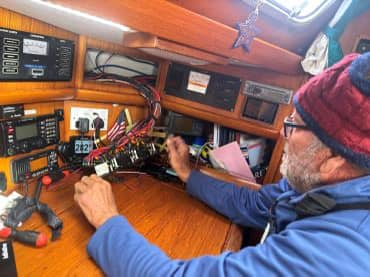
Life is good, until all the electronics go dark. Most, not all, the auto pilot continues working meaning that we both can focus on the problem rather than one person needing to drive. The breaker on the panel for navigation instruments and VHF has popped. Unscrew the panel to find everything dry and all wires firmly attached. No inline fuse, so suspect the circuit breaker. First attempt to move to a new breaker is not successful, but second is. Thank God, we have chart plotter and VHF radio again. Guy is more confident moving the wires around. Especially when we twice had sparks flying. I remember again why double handed sailing if my love. When things go wrong, and something always goes wrong, there is another person’s skill set to compliment my own weaknesses.”
Charlene & Guy
AJ Wanderlust
16 May 2024
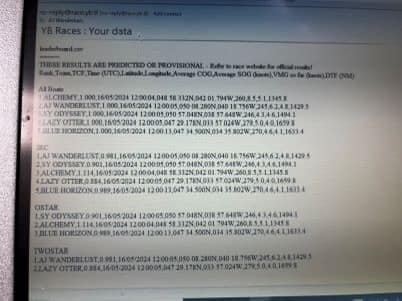
“Noon (British Summer Time) and end of TwoStar racing day 11, beginning of day 12. Happy, happy to see AJ Wanderlust leading in IRC overall !!! With the TwoStar race being 2,819 nautical miles, and AJ Wanderlust having a distance to finish of 1,429.5 nautical miles, we are at the halfway mark!”
16 May 2024
TwoStar
“Champagne Sailing
What a magical day in the North Atlantic Ocean. Fantastic wind direction and strength for AJ Wanderlust and sunshine ! Sunglasses on and a day of feet up, sitting in the cockpit, and simply enjoying the atmosphere. Loads of seabirds performing aerial acrobatics around the boat. While the sun dipped behind a frontal line before setting, the horizon this evening was filled with pretty pastel pink colours.”
Charlene & Guy
AJ Wanderlust
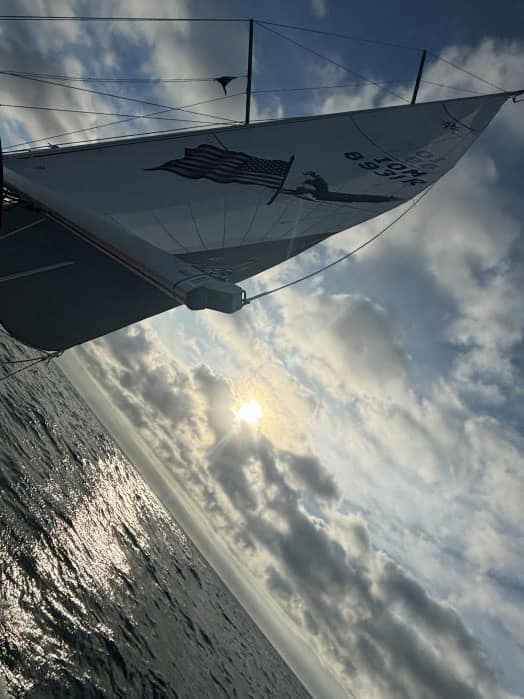
17 May 2024
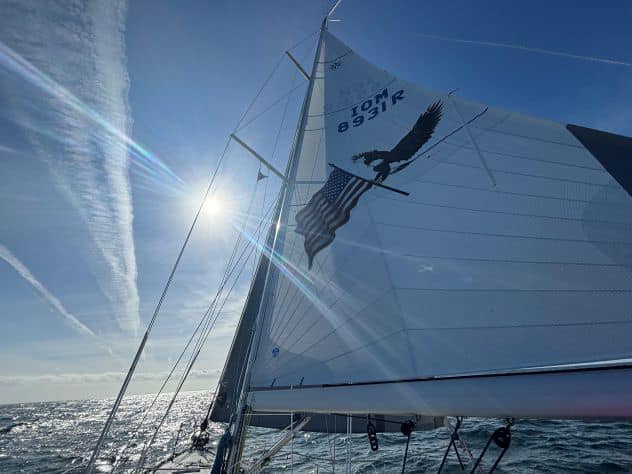
“What a lovely evening here by the Flemish Cap (where the Perfect Storm took place). It’s beautiful sailing for me as I’m sure for everyone else. Lots of fog the last two days- how Chichester coped is beyond me, but this evening is sunny and clear. See you in Newport assuming all goes well!”
David Southwell
Alchemy
TwoStar
“After storming along overnight with boat speed of 7 to 8 knots, AJ Wanderlust is presently becalmed and adrift. The strong south-easterly breeze that AJ Wanderlust enjoyed overnight began to decrease at noon today. In dying wind, we attempted a kite hoist at 2 pm. Dolphins came to swim around the boat and watch. Within 30 minutes, the kite had AJ Wanderlust heading north after wind shifted to the south. Spinnaker doused and we went to the 150% genoa, but within minutes the Windex atop the mast was spinning with variable winds lacking clear direction. Guy returned to drawing sketches in our trackline on the chartplotter. After another hour, we managed to get AJ Wanderlust settled on a south to southwest course, drifting about one knot in the correct direction. As of 6:30 pm BST, winds
remain at less than 3 knots and the sea swell rolls the boat shaking any wind from her sails. The Atlantic Ocean is glassy, and AJ Wanderlust sails.
are flogging hoping to catch a zephyr of air. The barometer is stable at 1003 hp and there are blue patches in the sky. We await the north-north westerly breeze that is promised around 3 am Saturday, but for the present AJ Wanderlust is parked in the middle of the big blue (no wind) weather pattern.”
Charlene & Guy
AJ Wanderlust


18 May 2024
“Ostar ’24 – Regatta across the Atlantic from Blue Horizon
#8 All the coffee of the world on the Gulfstream and an ocean drying day of everything.
This cruise is like sailing from one wind hole to the other.
After two days of sailing under the wind, I had the choice to sail more north or south. Long analysis of the weather forecast, however, suggest a more southern version. The north version isn’t bad if I swam a bit faster though. And so I’ll miss the best of it and I’ll be under strong wind again. Analysing, calculating and deciding to sail a little south. I saw such a corridor in the forecast, in which I want to catch once a half-wind from the north, and then, that is, today, a half-wind of the south. Tomorrow again the Bezwietrze bus stop no. X and after that it’s supposed to blow strongly from the east, that is, centrally from the roof. If I get my hands on it, there’s a chance I’ll reach the finish line in these six months.
Headed down south and almost everything would be fine if it wasn’t for this Gulfstream. He is generally ok because thanks to him we don’t have Siberian temperatures in Europe, but with me here and now, it doesn’t cooperate. Such ocean current has a mission to bring heat to Europe and flows at a speed of about 2 knots. You can see it all the time on the watches. My speed on water is almost always higher than the actual speed above the bottom (according to. GPS). So much work, energy for free. However, I have no choice and I build my tactics based on the wind plan.
Golf course and weaker wind still offer some opportunities. I declared yesterday morning an Ocean Drying Day. Humidity and waves will always find some cracks. Dry cabinets and nooks are squeezed everywhere, they become a bit like tourist attractions on the map of some non-tourist town.
I’m hanging all I can and making coffee. A choice of places, full coffee tables. At this time and in this place, this cafe does not have much decoration.
It’s so peaceful. Humming softly under the beak and very far from anything.
The Atlantic, its space and its colours are enchanting. To the max, almost hypnotic. Breath taking.
Running a little forward. There’s a chance I’ll be ok on the other side. a week to relax. Later the crew arrives for the return legs to Europe. We have three planned. 1st from Newport to Bermuda Second one on to the Azores and then Lisbon. We still have a free spot for the first two return stages. So, if you want a taste of the Atlantic to its fullest – I invite you.
More on our website under the cruises tab.
Pressing on, pressing on with Horizon.”
Jacek Chabowski
Blue Horizon
Powered by


Day 13
“TwoStar was a racing disaster for AJ Wanderlust, as we found our own personal wind hole and parked for 18 hours. The wind hole was in fact the centre of an elongated low-pressure system. Odyssey managed to escape to the north, and Alchemy to the west and south. Lazy Otter and Blur Horizon were farther to the east and thus in a different weather system. The light and variable winds saw AJ Wanderlust lose miles on her closest competitors. Prior to entering the centre of the low, AJ Wanderlust had closed to within 81.2 nautical miles of Alchemy and had extended away from Odyssey by 95.5 nautical miles. A mere 24 hours later. Alchemy had run away to a distance of 142.4 nautical miles and our lead on the water to Odyssey had slipped to only 25.4 nautical miles. AJ Wanderlust slipped to second in IRC Overall, after having led the pack for nearly a week. Guy and I are disappointed but committed to fight hard to the end for every inch on this racecourse. As of 8 pm on Saturday, 18 May, we still have 1,126.8 nautical miles to sail to the finish line. Thus, almost two-thirds of the race is behind us.
After 18 frustrating hours of extremely light and variable winds, AJ Wanderlust reached breeze at approximately 6 am this morning. Filling in from the north-north northwest, the velocity quickly increased from 8 knots to 15 knots. AJ Wanderlust spent the day under a full mainsail and full 150% genoa, often on an outboard lead, romping along at a solid 7 to 8 knots. White caps on the sea and sailing under blue skies with sunshine. An occasional fog bank would waft in an engulf the boat before again drifting away. There was a spectacular number of seabirds flying around AJ Wanderlust, proving a lovely scene from the cockpit. Today, we also began to encounter some of the Newfoundland fishing fleet on AIS and visually. The large 150-foot fishing boats plying the waters of the Grand Banks and the Flemish Cap.
One special treat during the hours of darkness last night was hearing whales blow nearby. We could not see these great mammals in the darkness of the misty night, but we were alerted to their presence by blows off the stern. Magical !
As of 10:30 pm this evening, AJ Wanderlust has launched her blue spinnaker to be able to sail deeper downwind during the night. The wind is from 45 degrees (northwest) and steady at 14 knots. The skies are overcast, and again we had no visible sunset and there are no stars visible in the sky. It is cold !!! and the off-watch bunk is becoming a haven with hot water bottles, multiple duvets, sleeping bags and fleece blankets.
AJ Wanderlust’s current course of 250 metric will bring her safely underneath/south of the ice limit reports that we received today.”
Charlene & Guy
AJ Wanderlust

The current standings show Polish sailor Tomasz Ladyko in the lead on corrected time for OSTAR, with David Southwell still in line honours position as he has been for the majority of the race. Alchemy is currently expected to arrive on the 26th May, 2 days ahead of Charlene Howard and Guy DeBoer who remain in the lead in Twostar.
A little further back Lazy Otter is only just over 1 day back on forecasted corrected time with an arrival around the 31st May. Blue Horizon is locked into a battle on the water with Lazy Otter and looks as though they will be in within a few hours of each other at the end of the month, so everything is to play for all over the racetrack as we enter the 3rd week of the OSTAR.
19th May
“Good afternoon- Well St Pierre and Michelon is probably a lovely place, but I’m sure it’s not known for its warmth! The temps were 35 degrees as I passed last night but the sailing has been fantastic. Now going VMG downwind in 20-30 knots of breeze. I tried out my fractional “bulletproof” spinnaker this morning and, well, three broaches later decided not to further test its fortitude. I’ll need it later in the race, so it’s big jib and main today. A beautiful cold sailing day.”
David P. Southwell
Alchemy
#twostar2024. Ostar and Twostar
“Almost 2 weeks since leaving Plymouth on May the 5th. So far, we have had no gales but often quite a bit of wind of mostly around 25 to 30 knots. These winds though lasted quite a long time, sometimes from the wrong direction sometimes the right fortunately.
There have been no breakages on Lazy Otter, only recently our Marks and Spencer food run out. We have been cooking on quiet days, mostly pasta. Predict Wind provide us with regular updates of weather, at times all 6 models different. But it’s a great help to know if any nasty weather may be in our way. Blue Horizon has been near us, but we have failed to contact recently as quality of the call was not clear. We’re looking at each day trying to do most miles at the right course. That works well apart from one night just after having strong headwinds where we both slept and Lazy Otter, which is steered solely by Hydrovane, changed course and steered us for a few hours south south-east. The wind direction had changed. We both slept soundly and felt guilt afterwards.
Our WhatsApp does not work so we cannot send decent photos but have regular contact with family via email. So far so good.”
Arriën Lekkerkerker and Ertan Beskardes
Lazy Otter


20 May 2024 – Racing TwoStar in the North Atlantic. Just out of bed. Purple fleece is atop four other layers of fleece and base thermals. Just out of view is the hot water bottle I am cuddling like a teddy bear. Sitting at chart table, hunched over Toughbook computer, and studying weather models.

20 May 2024 – TwoStar
Foggy day in the North Atlantic Ocean as AJ Wanderlust transits the Grand Banks of Newfoundland.
20 May 2024 – TwoStar
“Good night from AJ Wanderlust in the North Atlantic Ocean. Dolphins came to visit at sunset this evening.”
21 May 2024 –
“a night to remember”.
day 16 racing
Based on the forecast models, AJ Wanderlust decided to gybe the spinnaker at midnight to make some distance south in an effort to keep in stronger wind before the incoming light airs. The plan was to snuff and gybe, and rehoist. During the socking procedure, we had the boat running at a true wind angle of 165. This was too deep, and the clue of the spinnaker flew forward rather than out. The spinnaker began to wrap around the forestay, but with some manoeuvring, we were able to prevent a wrap. In the process of avoiding the wrap, the spinnaker twisted itself tightly around the blue snuffer lines. Well and truly tightly wrapped, there was no choice but to drop on the halyard and sort on deck. We put out the genoa to maintain a reasonable speed and decent direction; Guy and I went to work on the
foredeck untangling and repacking the spinnaker into the sock. This took around two hours before we could hoist again. The spinnaker was hoisted on the new gybe and AJ Wanderlust sailed south. Thankfully, the night is mild with only 13 knots of wind and a flat, dry deck to work on. Guy and I made a hot drink and debriefed. On looking at the gybe angles, there has been a 20-degree wind shift, so we gybe AJ Wanderlust back. I maintain a watch at the top of the companionway steps, my favourite spot when cold water/cold climate sailing. AJ’s speeds are fantastic in the 8-knot range and her course is 255 degrees. Bang – and the spinnaker is flying sideways. We have blown the tack line, or more specifically the tack shackle. I wake Guy, so we can wrestle the spinnaker down. Guy heads forward to snuff, but the sock is tangled and only lowers about a foot. Now, we are both on the foredeck trying to get “The beast” down. Each attempt to bring together clue and tack and snuff wind fails, as the spinnaker catches wind and billows away threatening to pull us off the deck. We cannot physically reattach the tack while the spinnaker is hoisted, it must be dropped to the deck. Once again, the genoa
is unfurled to shelter the spinnaker from wind during the drop and to keep AJ Wanderlust moving with moderate speed and direction, while the spinnaker is repacked into the snuffer/sock. This time, we are careful to run the blue snuffing lines the full distance top to bottom of the snuffer sock, to ensure no tangles or snags to the lines. Spinnaker ready to go, we again hoist. Immediately on hoisting, I call for a drop, as the spinnaker sheet block has pulled in not only the spinnaker sheet , but the bag of the heavy weather jib sitting on deck. Thankfully, the spinnaker snuffs with no issue. We free the bag and unshoot the spinnaker. But why is the lazy sheet tucked under the bow ? On closer inspection forward, the tack line and lazy genoa sheet are wedged into the bottom of the roller furler and headstay fitting. We rig a temporary tack line to ease pressure and free the original.
It has now gone 9 am BST (British Summer Time), and after 9 hours of “spinnaker fun”, AJ Wanderlust is back sailing at full speed and on the correct course !!! The spinnaker has once again proven itself a mischievous creature ! Guy is sleeping and I am keeping active to stay awake for a few hours before my turn to sleep. Miraculously, despite the eventful overnight activities, AJ Wanderlust remains at first place in Yellow Brick IRC leader board ratings.
While AJ Wanderlust and crew plan to give it 110% to remain atop the leader board, we recognize there are some very well sailed boats in the OSTAR and TWOSTAR fleet, and thus expect stiff competition to the finish in Newport, Rhode Island and minutes will matter.
During the night, while AJ Wanderlust was experiencing her spinnaker mishaps, the cruise ship “Queen Mary 2” passed to port. It is impossible not to remember that in the 2016 edition of OSTAR (a race which runs each four years), the legendary OSTAR sailor Mervyn Wheatly was rescued from his sinking boat “Tamarind” by the Queen Mary 2. A terrible and fierce storm hit the fleet that year. I had the privilege of sitting beside Mervyn at the “Half Crown” dinner the Thursday night before our race began. It was Mervyn who first planted the OSTAR/TWOSTAR idea in my head in 2019 whilst racing AZAB (Azores and Back). Thanks for the encouragement, Mervyn !!!”
Charlene and Guy
AJ Wanderlust
21 May 2024
After an eventful overnight with the spinnaker, today was blessedly relaxed with a steady northeasterly breeze. The constant wind permitted easy watches and the opportunity to catch up on rest. Much of today featured dense fog, and poor visibility. However, this evening was gloriously clear with a bright full moon reflecting silver on the water and stars in the sky.
Charlene and Guy
AJ Wanderlust

22nd May
As we close in to the finish of this 2024 edition of the OSTAR and TWOSTAR, conditions are settling and the fleet are enjoying 20knots of breeze, albeit from the West Southwest which will mean that headsails are likely to be the only sail plan for the coming few days.

On or around the 26th May, shortly after Alchemy is expected to finish, there is a weather system expected to emerge Southeast of Nova Scotia which will build and effect the rest of the fleet with South-easterly winds which will veer to the south as they approach Newport. This is hugely significant, not for line honours as this will have been claimed, but for Twostar and for both races on corrected time. It is unlikely that we will be able to call this until the final days and hours. For a race that has seen the lowest entry since its first race back in 1960, this is likely to be the closest fought final few days on record. It is also likely that this will mirror that first race where 5 boats started and all 5 boats finish.
Just in;
“Good morning- After a devilish calm yesterday that had me re-reading The Ancient Mariner we are now heading in the right direction. “We stuck, nor breath nor motion” for six hours. The low that gave us northerlies has now moved out and been replaced by a typical New England sou’wester. It’s a gorgeous morning, and a land bird that was clearly having navigational problems 200 miles offshore has taken up residence. We are conversing about the rediscovery of the sun.”
David Southwell
Alchemy
Expected weather system following the finish of Alchemy.

22 May 2024 – TwoStar
“Today at noon, AJ Wanderlust completed her 17th day of TwoStar racing. We are now in our 18th day of racing. The rhythm of life at sea has taken over and time is less meaningful than when ashore. We eat when hungry and sleep when tired. Our world revolves around downloading weather twice daily and determining a best course to sail based on the detailed grib files. AJ Wanderlust is the most critical player in this ocean environment, and her needs dominate all others. Her crew (Guy and myself) do all possible to ensure she sails safe and fast.
This morning, with the wind shift to the southwest, began what will be a 600-mile upwind beat to the finish. Throughout the day the sea state has increased, but AJ Wanderlust is riding comfortably under one reef in the mainsail and two reefs in the genoa. We are in 18 knots of true breeze from a direction of 250, and our apparent wind speed is roughly 25 knots.
The boat is heeled over, and so life is lived at about a 40-degree angle. The simplest of tasks, such as making a coffee, going to the toilet or getting dressed, become acrobatic feats in the constantly moving environment. Food is served in “dog bowls” – wide and deep, so you can hold them at chin level and shovel food into your mouth without it flying away.
As of 11 pm this evening, we are 70 miles southeast of Sable Island. AJ Wanderlust is presently sailing south. Our VMG (velocity made good) is abysmal on this tack, but we hope it will be strategic to keep the boat in the best wind for future hours/days.”
Guy and Charlene
AJ Wanderlust
Meanwhile, Blue Horizon continued to be locked in an ‘on the water battle’ with Lazy Otter. This rivalry had been from the very start and has not softened up at all in the entire race. Screen shots of the instruments onboard show the fantastic headway Blue Horizon was making in what were surely some of the best conditions in the entire race.


Up ahead things were very different….
23 May 2024 – TwoStar
“As of midnight, end of Thursday, 23 May, AJ Wanderlust is 150 miles south of Nova Scotia. After an incredibly frustrating 24 hours of very bad racing for AJ Wanderlust, we are finally making progress at 7 knots toward Nantucket Banks and the finish line. Dense fog and cold this evening, after a sunny afternoon in the North Atlantic Ocean.
Over the past 24 hours, there appeared to be an adverse current of about 1.5 knots against the boat, but no such current is shown on the tidal Atlas, and we are too far north for the Gulf Stream. Either way, the track of AJ Wanderlust on the chart plotter looks like we were drawing the Alps with reciprocal tacking angles of 195 and 320 degrees. Disappointment aboard due to the fact that as of midnight last night, AJ Wanderlust was first overall IRC and today midnight we are third. Working hard to regain some of what we have lost.
Lots of analysis today as to what went wrong, our strategy and interpretation of the weather files or just a case of being in the wrong place at the wrong time. Definitely a moment to remember the bigger picture, and that despite desires to be competitive, sailing oceans is an incredible adventure and wonderful opportunity to be in the heart of nature.”
Charlene and Guy
AJ Wanderlust
Whilst AJ Wanderlust were enjoying the agonies of uncharted head currents, up ahead there were problems of another kind for our pole sitter….
“Good morning- You may have noticed that I’ve slowed quite a lot- my jib halyard broke yesterday evening. It’s at the top of the mast and would necessitate a mast climb to fix, up with which I am not for. So I rolled it up and am using the inner jib with two cannonball-sized holes in it. These were either caused by the gale on my northern misadventure or by an attack from Greenland vikings. I’ll never tell, but the combination of the bad airfoil caused by the fat sausage on the bow and the holes is costing me a knot and a half at least. Suffice to say I will look like a typical OSTAR boat on arrival- thoroughly battered.”
David Southwell
Alchemy
24th May
200 miles to go for Alchemy. Conditions remain challenging as we see 20knots on the nose for their next 24 hours. A TSS extending out the South East from Boston will force Alchemy south which will most likely be in a similar time to the breeze shifting right, forcing further upwind conditions as they approach the final 100 miles. From there conditions get light and variable. Further back we see very different, more favourable weather which will free off the fleet with south-easterly breezes which continue to veer to southerly by the 28th May, which happens to be the expected finish date of the rest of the fleet.

As we close into the final days of the race, and whilst the top 3 on the water seems relatively decided, it has literally never been closer on corrected time! For the 3rd time in as many days we have a new ‘dual fleet leader’ on IRC. With an estimated corrected time at the finish of 23days 13hours and 7 minutes, Lazy Otter sits proud at the top of the leader board. This includes a penalty for breach of SI 14.1 – (details of which are on the website notice board). AJ Wanderlust, only 1 hour and 14 minutes back on corrected, are recovering from their last 24 hours of torment and are still very much in the hunt for the overall TWOSTAR honours over Lazy Otter. Whilst seemingly unlikely to be caught on the water for line honours, Alchemy will also have an eye on their corrected time and bragging rights should they manage to top the ‘Corrected time’ board but need to find 4 hours and 15 minutes on their rating to do this. Judging on their performance to date, this is by no means over. Alchemy has consistently performed in excess of their rating but have had one or two gear issues which have anchored them further into the fleet than they would like. Forth on corrected and on the water, we see Odyssey only 1hour 34 minutes back from Alchemy, their arch rivals for OSTAR victory. Then we have Blue Horizon who are challenging Odyssey for their best position on the water. Everywhere you look there are opportunities for change. The coming days are going to be shifty, challenging and with the TSS positions as they are we are in for some great tactical racing as we close into the finish of OSTAR TWOSTAR ‘24.

All is still to play for…..
At precisely 23.01hrs on 25th May, Alchemy crossed the finish line to win Line Honours in the OSTAR2024! We congratulate David Southwell on a fabulous result!!!
David was met at the finish line by Assistant Race Director, Norman Bailey and the Newport Harbourmaster escorted him to the NYC along the Newport harbour front with siren and lights. David had ice cold champagne and Dianne presented him with a bag of sweets, fruit and ice-cold beer on behalf of the club as she done for every finisher since 2009.
More photos soon!
Photo:
Commodore Robert Antignano, David Southwell, Asst Race Director Norman Bailey


Good morning gents- well you missed a Newport harbourmaster escort to the slip and quite a reception when I got there. Thanks for running a great race. I’ve wanted to do the OSTAR since I was a kid. Yours is the only solo transatlantic race that really works for amateurs, Corinthians or whatever you want to call us.
All the best,
David
Alchemy
26 May 2024 – TwoStar
Dawn aboard AJ Wanderlust arrived with mirror-like seas in the North Atlantic Ocean. The glassy waters featured not a breath of wind. Around 12 noon, the breeze came from the southeast at 3 knots. AJ Wanderlust hoisted her kite. By 2 pm, the southeast wind had strengthened to 8 knots, and was building. AJ Wanderlust had a fast afternoon and evening under the blue spinnaker and full mainsail. Sunset this evening featured colours of bright yellow-orange and vibrant pink. Dolphins played alongside AJ Wanderlust. Tonight, we are sailing under a million stars in the dark sky. A large number of New England fishing boats are to the starboard side of AJ Wanderlust fishing George’s Bank.
Shipping traffic has greatly increased today as we approach the major shipping lanes to Boston. Getting close now and AJ Wanderlust anticipates a
very busy next 36 hours.
At present, it is 4:30 am BST on Monday, 27 May (Memorial Day) and a deep orange moon is rising above the Atlantic Ocean horizon.

27 May 2024
“Memorial Day in the USA, a time for remembering those past. In my family, a time for tending to cemeteries and planting flowers on graves. Bob, my brother, is seeing to the initial planting of flowers this year, while AJ Wanderlust races TwoStar. Shortly after finishing, I will be returning to my hometown in Michigan, to finish the job as Bob is leaving me space to plant flowers also. Carrying on a precious tradition of remembrance. Mom always wished that the family graves would be lovingly cared for. after she was gone. So today, AJ Wanderlust remembers her namesake, Amon James (AJ), my Father and a US Army veteran of World War 2. AJ Wanderlust also remembers the source of her sail racing number (8931) – August 9, 1931 – the birthday of my Mother. As of noon, British Summer Time, today AJ Wanderlust completed her twenty-second (22) day of racing TwoStar. The Yellow Brick tracker says that we are 125.3 nautical miles from the finish. For the moment, AJ Wanderlust holds an extremely tenuous lead in IRC overall. Once we finish, the clock begins ticking for the boats still racing. Once on the dock, AJ Wanderlust can do no more than wait. In this IRC handicapped race, the winner is decided on corrected time. We believe AJ Wanderlust will have good wind to the finish and believe the same true for boats coming astern. The one certainty is that this Ostar/TwoStar has been highly competitive. The sky is overcast, with about 85% cloud cover today. The temperature is pleasant, with only a heavy fleece being required. A nice change from the multiple layers of clothing we have worn most way across the Atlantic Ocean. The breeze is from 145 degrees (southeast) at 13 knots. AJ Wanderlust is sailing under her blue reaching spinnaker and full mainsail. Seas are slight.
27 May 2024
At 9 pm BST, AJ Wanderlust is 67.7 nautical miles to the finish in Newport, Rhode Island. True wind angle is 163 degrees, and we have 19 knots of breeze from a direction of 145 (southeast). Powered up under the blue spinnaker to the finish. Go fast, AJ Wanderlust, go fast !!!
28 May 2024 – TwoStar FINISH
AJ Wanderlust crossed the finish line in Newport, Rhode Island at 06 hours, 27 minutes and 41 seconds UTC on Tuesday, 28 May 2024. Said another way, 22 days, 19 hours, 27 minutes and 41 seconds from Plymouth, UK to Newport, Rhode Island, USA.
Many and great thanks to Norm and Dianne who met AJ Wanderlust on the Newport Yacht Club docks at somewhere around 3 am. Guy and I appreciated the beer and chocolate cake !!!
AJ Wanderlust’s final hours of TwoStar were eventful. The blue kite blew its tack in a broach at 3:30 am, and the rip extended midway up the spinnaker. Full damage assessment still pending. Soon after the wind gust that caused the broach, the skies flashed bright with heat lightening and roaring thunder; only one lightning bolt sighted. This spectacular light show continued from alongside the Buzzards Bay TSS all the way to Brenton Reef red buoy. Roaring thunder sounds amazingly similar to a luffing genoa, at least to tired sailors. The rain was torrential. Definitely a TwoStar finish to remember !
Charlene Howard & Guy Debour
AJ Wanderlust
29th May
As morning breaks the conditions become challenging with the breeze on the nose as the rest of the fleet fight their way to the finish minding the TSS as they go. Tomasz Ladyko on SY Odyssey starts short tacking to climb around the TSS at 0200 and finally is able to free their course just after midday. By 0900BST Ladyko is clear of the final TSS and well on his way to the finish. By this time further back both Lazy Otter and Blue Horizon are also Clear and able to free off towards the finish.
30th May
With an official time of 12:58:38BST on Thursday 30th May, Tomasz Ladyko and SY Odyssey is our 2nd place finisher for the OSTAR 2024!


Tomasz takes provisional 2nd on Corrected time behind Alchemy, which is likely to remain this way as Blue Horizon is unable to finish ahead.
All eyes are now on Lazy Otter who has to finish tonight in order to have a chance of beating AJ Wanderlust on corrected time. With champagne currently on ice, Charlene and Guy will be watching the clock for several hours, as Lazy Otter’s hopes gradually fade by the hour. Her expected arrival and finish time is tomorrow morning which will be enough for AJ Wanderlust to take the glory.
Over 120 spectators consisting of family, friends, Royal Western Yacht Club members and press were treated to a fantastic start to the OSTAR and TWOSTAR race, the 60th anniversary of the OSTAR that had been postponed for 2 years due to Covid. 6 nationalities were represented, that being Poland, United Kingdom, Switzerland, Belgium, France and the Netherlands. Early pace was shown by Michal Kopanov sailing his Faurby 39, ‘Krone One’, Marcus Moser on ‘Lifgun’ and Jankees and Floris Lampe sailing in the TWOSTAR on ‘La Promesse’. Jankees had previously won the OSTAR in 2009 and was returning with his son this year with the aim of beating his previous winning time of 15 days.
Headlining a weekend of social events was the Half Crown Club Dinner, an exclusive invitation to those who have raced in previous OSTAR editions to meet and spend time with the new competitors taking part in this, the oldest of all single handed oceanic races, the one that set the way for all others to follow and remains a springboard to those who have their sights on professional campaigns such as the Route de Rhum and the Vendee Globe. Indeed, the OSTAR / TWOSTAR remains one of the toughest yacht races in the world, with not only the Grand Banks off Newfoundland with its moving seabed, but thick fog, ice cold temperatures and not forgetting the continuous prevailing headwinds.
The dinner was hosted by commodore Chris Arscott. Also present were dignitaries from the finish host club, the Newport Yacht Club, included the Vice Commodore Mr and Mrs Robert Antignano and the US Asst Race Director, Mr Norman Bailey, along with the Royal Western Yacht Club race management team.
Saturday was devoted to preparation and rest, with a number of entries still making their final adjustments to ensure they hit the line in perfect condition to take on this Goliath of ocean yacht races.
Race morning and the weather briefing followed what was a brief, but detailed presentation of the start procedure given by RWYC Commodore Chris Arscott. All boats were to muster to the north of the start line, being Melampus and F Buoy, then await the starting sequence which was relayed by race director Adrian Gray. Conditions were sedate, which allowed everyone to get away cleanly and head out on their first leg of the course being a fetch to the Eddystone Lighthouse which they were to leave to starboard.
Early pace setters were ‘La Promesse’ with a sizeable lead on the pack lead by Marcus Moser in ‘Lifgun’, closely followed by ‘Krone One’ and Michal Kopanov. By 1300UTC Herve Dupriez in his Rustler 36, ‘Polynya’, had passed the Eddystone which meant that the entire fleet had managed the first leg in great time.
Once south of Ireland, the weather systems were showing as predicted, a low pressure tracking north-east at a pace which would split the fleet. This brought what would be the biggest decision for the first part of the race, head north and press hard to go over the top of the low or take the southern route and keep more to the rhumb line.
Conditions gradually worsened through the coming hours which saw some very early disruption to both single and double handed entrants. Conditions were tough with strong winds and confused seas causing a number gear issues, notably with autopilots. All boats carry 2 autopilots but even with two it was soon very apparent that this was not sufficient to cope with the weather system the fleet found themselves in. Within the first 72 hours, ‘Oddesy’ and ‘Hultaj’ had no choice but return to port, closely followed within 24 hours by ‘Krone One’ and ‘Blue Horizon’. These boats had made the tough decision to turn away from the storm and head towards port in order to effect repairs wherever possible before facing the solitude of the Atlantic Ocean.
Of those who turned for port, only ‘Hultaj’ would re-join the race. Jacek Chabowski announced his retirement due to technical issues, Tomasz Ladyko returned to Plymouth with gear failure, primarily autopilot, and Michal Kopanov reported damage to the furling drum along with loss of fresh water due to a leaking tank and electronic issues. By now the 2 heading north with a chance of making it through the low had split, that being Jankees and Floris Lampe onboard their open 40 ‘La Promesse’ and Neil Payter on his open 40 ‘Cariberia’. Within a matter of hours, Payter was seen to be turning in an easterly direction some 300 miles northeast of the northern Irish coast. Comms were lost but the tracker continued to show movement for another 12 hours, when all signs of communication were lost. At this point a precautionary call was made to HM coastguard and a local watch notice was sent to all passing craft in that region. As concern grew for Payter, Lampe was now through the centre of the low and heading on a more south-westerly route whilst enjoying a short respite that the eye of the storm was allowing them. Of the other boats in the fleet, the beautiful Pegasus 50 ‘Lifgun’ was progressing in a southerly direction having got as close as he could to the favourable winds to the west of the low, closely tracked by Keith Walton on ‘Harmonii’. Now the presence of James Mansell on ‘Escape’ was being felt. Mansell had stuck to the rhum line on a course further south which brought him into the race to split ‘Lifgun’ and ‘Harmonii’ and establish himself as leading the race on corrected time.
By now all who were able to re-join had done so with the Beneteau figaro ‘Hultaj’ being the last to leave their shelter on the southern-most point of Ireland where they managed to repair the damage to the autopilot mechanical connection to the tiller. As the majority of the fleet began to settle into the race ahead of them, a spread of over around 1000 nautical miles developed. Now each entry faced their own challenges, and the race became not only a physical battle but a mental one too.
The watch system within the RWYC continued to monitor the progress of the entire fleet, whilst focus was particularly shared with the HM coastguard on Neil Payter and ‘Cariberia’. By now 72 hours had passed and so, following no sightings of ‘Cariberia’ and no tracker feedback since 1600 on the 20th of May, HM Coastguard decided to deploy a fixed winged asset to survey the area with an update on that survey expected in the early hours of the following morning.
The next call with HM Coastguard brought news of Payter’s ‘Cariberia’ being spotted, a sail was visible but as yet with no signs of life on board. Now that there was a positive visual of the boat it was decided to deploy both coastguard search and rescue helicopter and the nearest offshore lifeboat to find and stabilise ‘Cariberia’.
Within just a few hours the rescue teams were able to contact the skipper who was otherwise safe and well, albeit the boat had lost all comms (other than a handheld VHF) and its autopilots. Although later it came to be known that Payter was actually down below resting having had to steer for many hours in compromising conditions and without autopilot, he accepted the outside help of the rescue services and was then towed into safety, ending Payter’s chances for completing the race for this year, however it is clear that this is now unfinished business. Most importantly Neil Payter was fit and well, albeit exhausted, which came as great relief to his family, friends and all those watching social media from afar. The damage list was extensive, including sail damage, autopilot failure, electrics finally shutting down and the water ballast transfer hose coming apart from the system.
Back out in the Atlantic and there were a number of small battles happening throughout the fleet, not least on ‘Lifgun’ and a private battle Markus Moser was having with gear failure. Whilst sailing with a code zero, the Bobstay let go and sent the bowsprit skywards, causing issues with sail selection particularly when just off the breeze. This was followed some days later when the boom creased at the vang fitting, further damaging the ability to press as hard as he would have liked. Moser strapped up the damaged boom as best as he could which enabled him to get somewhat closer to optimum speeds.
Meanwhile, James Mansell and ‘Escape’ were enjoying life as he continued to lead on corrected time over ‘Lifgun’. This was not without incident or indeed injury. Indeed Mansell was sustained a broken rib during 1 of a number of pretty big knockdowns. This was to trouble him for the majority of the remaining race, not least during a bout of seasickness reminding him that ribs are not the quickest injury to repair or get over, especially racing solo in the Atlantic Ocean. Some days later ‘Escape’ would have a jib car explode forcing Mansell onto the foredeck, broken rib and all, during a particularly bumpy 30 knots, so he could rig something up so as to be able to trim the jib for the remainder of the race. Mansell was to recall this in his daily reports as “it was like a bucking bronco ride with someone directing a fire hose at me every now and again”
Wildlife is also a big topic for this race. It makes for a period of time where something else is the main focus other than keeping the boat in good shape and pointing in the right direction whilst minimising any chance of causing damage. ‘Harmonii’ was joined by a number of sea birds, including Fulmars and Petrels, and later a pod of pilot whales including a baby one in the group.
Day 15 and we were to lose the tracker on ‘Hultaj’. Being a smaller boat and at the tail end of the fleet can sometimes expose that boat to more danger as the fleet are always getting further away. Fortunately the race management team were able to get a message to Szymon Kuczyski to send daily position updates back to the race office via text messages so as to keep communications live. This happened for the entire rest of their race across the Atlantic.
June 1st and US asst race director Norman Bailey’s phone rings, it’s the TWOSTAR entry of Jankees and Floris Lampe on ‘La Promesse’ announcing their imminent arrival to the Rhode Island headland and their TWOSTAR race finish. Welcome vessels gathered and celebrated their crossing the finish line with a time of 21 days, 11 hours, 22 minutes and 10 seconds. Although this was longer than Jankees OSTAR 2009 winning time of 17 days, 17 hours and 40 minutes it was nevertheless the first time someone had won both OSTAR and TWOSTAR, it was also the first father and son victory. No doubt this will not be the last time we see the name Lampe as with a younger brother, Wouter, equally as keen to take on the world of 2 handed oceanic racing it’s only a matter of time before we see ‘Team Lampe’ on the start line once again.
Next in, and long-time OSTAR line honours leader, Markus Moser who was making his mark in the oceanic race history books. With a finishing time of 24 Days, 49 minutes and 4 seconds Marcus Moser and ‘Lifgun’ was out of reach for the rest of the OSTAR class on IRC also and was therefore declared the OSTAR 2022 line-honours and IRC winner.
Following them in was James Mansell on ‘Escape’ with a hugely respectful time of 25 days, 8 hours, 4 minutes and 35 seconds. The familiar Newport Yacht Club warm welcome greeted him, consisting of a welcoming crowd and a bag of local produce, which included a much-deserved beer or two!
Next in, some 2 days later, was Herve Dupriez on Polynya. Again, a tremendous achievement for the Frenchman in one of the smallest boats in the fleet. Then some 2 ½ days later Keith Walton and ‘Harmonii’ were next to finish in the TWOSTAR class. Walton has entered the OSTAR before but was unsuccessful. This time and with the help of his co skipper, Jay Beeken, he has fulfilled the dream of finishing this formidable racecourse.
Following ‘Harmonii’ was to be Szymon Kucynski and Ann Jastrzebska onboard their Beneteau Figaro ‘Hultaj’ with a time of 31 days, 33 minutes and 58 seconds. This was quite possibly the toughest way to complete the race. 25ft long and with a failed autopilot forcing them to turn back, these 2 intrepid sailors stuck at it and went on to finish where many would have taken their gloves off and made a B Line for the showers!
2022 results
OSTAR
1st & Line Honours Lifgun Markus Moser
2nd Escape James Mansell
3rd Polynya Herve Dupriez
TWOSTAR
1st La Promesse Jankees & Floris Lampe
2nd Harmonii Keith Walton & Jay Beeken
3rd Hultaj Szymon Kucynski & Nana Jastrzebska
And so this wraps up a very successful, 60th Anniversary OSTAR race along with the TWOSTAR race. Our heartfelt thanks go to all the support volunteers on both sides of the Atlantic, a particular mention goes to the race office duty officers who covered all comms 24 hours a day for the entire race, and Norman Bailey, USA Asst Race Director, without whose help, running the race would be a very difficult challenge in many ways.
Our thanks must also go to MailASail. We have a great relationship with our sponsor, and we are pleased to announce that they will once again be title sponsors for OSTAR TWOSTAR 2024.
Finally, MailASail OSTAR TWOSTAR 2024 will be showcasing a very exciting 3rd class. The ‘OSTAR Classic’ Class which will be for all boats that competed in races before 2008. We also welcome all sailors who have entered the race before with a special Half Crown Club members entry fee.
Further information including day by day commentary on the race from Nigel Mansell and Marcus Moser – the OSTAR 2022 winner – can be found on the OSTAR TWOSTAR Facebook page, also the winning boats stories as they unfolded can be seen on ‘La Promesse’ Blog – https://ned7576.com/ , ‘Lifgun’ Blog – https://lifgun.com/